Best 120Hz Ultrawide Monitors: 15 Spec-Based Picks
As an Amazon Associate we earn from qualifying purchases. Links on this page are affiliate links.
Choosing the ideal 120Hz ultrawide monitor or standard screen comes down to balancing display space and refresh rates. We compared 15 products based strictly on the specifications published on their listings.
The Philips 22-Inch 120Hz IPS Monitor takes the top position because its compact 22-inch IPS panel delivers smooth 120Hz output with wide viewing angles for space-constrained desks. This comparison helps you decide which screen size, panel type, and connectivity options fit your daily computing and desk layout needs.
Quick picks
The best fit for you
- You need a compact 120Hz screen for small desks Philips 22-Inch 120Hz IPS Monitor Its 22-inch IPS panel delivers 120Hz motion while occupying minimal desktop space.
- You want an ultrawide screen for UWQHD multitasking MSI 34-Inch 120Hz UWQHD Ultrawide Monitor The 34-inch display provides 3440 x 1440 resolution at 120Hz for expanded horizontal workspace.
- You want a massive super-ultrawide dual-QHD workspace Amzfast 49-Inch 120Hz DQHD Curved Monitor A 49-inch curved panel provides 5120 x 1440 DQHD resolution to replace dual-monitor setups.
- You prioritize 4K resolution with QD-OLED panel tech Dell 32-Inch 4K QD-OLED Monitor The QD-OLED panel pairs sharp 4K UHD resolution with a 120Hz refresh rate.
Our 15 picks
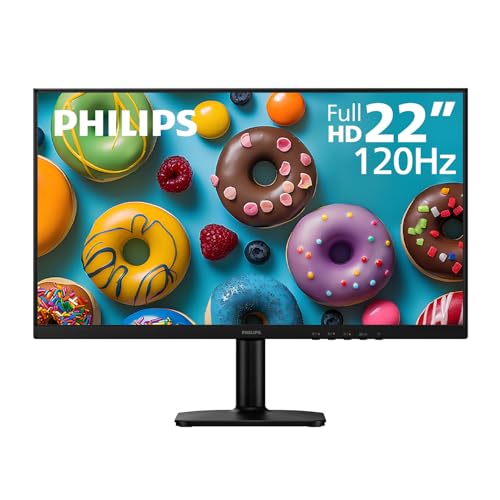
Philips 22-Inch 120Hz IPS Monitor
Best for: compact desks needing 120Hz refresh rates
- Refresh Rate
- 120Hz
- Screen Size
- 22"
- Resolution
- 1920 x 1080
- Panel Type
- IPS
- Response Time
- 1ms MPRT
- Sync Technology
- Adaptive-Sync
This is a compact 22-inch (21.5-inch viewable) display featuring a 1920 x 1080 Full HD IPS panel. It runs at an overclocked 120Hz refresh rate with Adaptive-Sync and a 1ms MPRT response time for fluid frame transitions. The 178-degree viewing angles and slim bezels suit multi-screen arrangements. If you need a fast refresh rate in a tight desk space, this monitor fits your setup without demanding extra room.
Pros
- Overclockable 120Hz refresh rate with 1ms MPRT
- IPS panel with 178-degree viewing angles
- Adaptive-Sync support for tear-free visuals
- Standard 100x100mm VESA mount compatibility
Cons
- 120Hz refresh rate requires overclocking
- Compact 21.5-inch viewable screen area
- Only HDMI connectivity listed
Good fit if
- You need a 120Hz display that fits onto a smaller desk surface.
- You want wide 178-degree viewing angles from an IPS panel.
- You plan to mount your display using a standard 100x100mm VESA bracket.
Skip if
- You want a true ultrawide 21:9 aspect ratio display.
- You need DisplayPort connectivity for your setup.
- You prefer a native 120Hz refresh rate without overclocking.
Verdict: Philips 22-Inch 120Hz IPS Monitor provides a 120Hz overclocked refresh rate and wide viewing angles on a compact 1080p panel. It serves well if your desk setup requires a smaller display footprint.

Dell 32-Inch 4K 120Hz Monitor
Best for: sharp 4K gaming and multimedia workflows
- Refresh Rate
- 120Hz
- Screen Size
- 32
- Resolution
- 4K UHD
- Response Time
- 0.03ms
- Sync Technology
- AMD FreeSync Premium
- Panel Type
- VA
This Dell display pairs a 32-inch 4K UHD screen with a 120Hz refresh rate and AMD FreeSync Premium. You get a VA panel featuring a 1500:1 contrast ratio, 95% DCI-P3 color coverage, and a 0.03ms response time. It suits you if you want high-resolution 4K clarity, smooth motion, and built-in speakers for desktop gaming and daily media work without stepping down to lower-resolution panels.
Pros
- 4K UHD resolution across a 32-inch VA panel
- 120Hz refresh rate with AMD FreeSync Premium support
- 0.03ms response time
- 95% DCI-P3 and 99% sRGB color coverage
Cons
- Standard 16:9 4K aspect ratio rather than an ultrawide format
- Only HDMI connectivity listed in specifications
Good fit if
- You need a sharp 4K UHD resolution at a smooth 120Hz refresh rate.
- You want wide color coverage covering 95% of the DCI-P3 space.
- You prefer an integrated speaker setup to reduce desktop clutter.
Skip if
- You require a native 21:9 ultrawide aspect ratio.
- You need DisplayPort or USB-C connectivity on this specific configuration.
Verdict: Dell 32-Inch 4K 120Hz Monitor delivers crisp 4K visual clarity with smooth 120Hz pacing and wide color reproduction. It is a solid premium desktop choice if you prioritize resolution and motion over an ultrawide aspect ratio.

Acer 23.8-Inch 120Hz IPS Monitor
Best for: compact desks needing smooth 120Hz IPS visuals
- Refresh Rate
- 120Hz
- Screen Size
- 23.8"
- Resolution
- 1920 x 1080
- Panel Type
- IPS
- Aspect Ratio
- 16:9
- Response Time
- 1ms VRB
This monitor gives you a 23.8-inch IPS panel running at 1920 x 1080 resolution. It features a 120Hz refresh rate and Adaptive-Sync support for tear-free frame pacing. A 1ms VRB response time handles fast screen transitions, while peak brightness measures 250 nits. If you want a compact 1080p display with a high refresh rate for general office work or basic gaming, this screen matches your everyday workspace setup.
Pros
- 120Hz refresh rate delivers smooth frame output
- IPS panel provides Full HD 1920 x 1080 resolution
- Adaptive-Sync support eliminates screen tearing
- 1ms VRB response time reduces motion blur
Cons
- Standard 16:9 aspect ratio rather than ultrawide format
- Modest 250 nits maximum brightness
Good fit if
- You need a compact 23.8-inch screen with a 120Hz refresh rate.
- You want an IPS panel with Adaptive-Sync compatibility.
Skip if
- You require an ultrawide 21:9 aspect ratio for multitasking.
- You need a display brighter than 250 nits.
Verdict: Acer 23.8-Inch 120Hz IPS Monitor provides solid 1080p visuals and 120Hz motion in a space-saving 23.8-inch format. It is a practical pick if you want reliable speed without an oversized footprint.
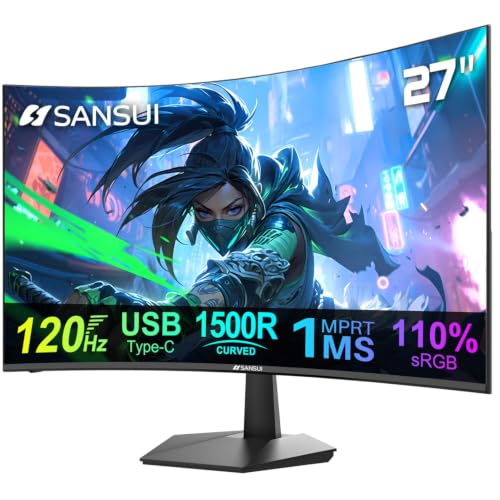
SANSUI 27-Inch Curved 120Hz USB-C Monitor
Best for: curved desktop setups needing USB-C video
- Refresh Rate
- 120Hz
- Screen Size
- 27 inch
- Response Time
- 1ms (MPRT)
- Sync Technology
- Adaptive Sync
- Connectivity
- USB Type-C, HDMI 1.4
- Dimensions
- 8.31 × 24.1 × 17.9 inches
This 27-inch curved monitor combines a 120Hz refresh rate with USB-C and HDMI 1.4 video inputs. You get a 4000:1 contrast ratio, 300 nits brightness, and 110% sRGB color gamut coverage. Dual 2W built-in speakers handle desktop sound, while Adaptive Sync supports smooth visuals. It suits you if you want a high-contrast curved display with single-cable USB-C convenience for your daily workstation or casual gaming setup.
Pros
- USB Type-C and HDMI 1.4 ports
- 120Hz refresh rate with Adaptive Sync
- 4000:1 contrast ratio and 300 nits brightness
- Built-in dual 2W speakers
- VESA 100 x 100mm mounting support
Cons
- Stand offers tilt only without height adjustment
- No DisplayPort connectivity
Good fit if
- You need a USB-C connection for your laptop or desktop.
- You want a 120Hz curved screen with high 4000:1 contrast.
- You prefer integrated stereo speakers for everyday audio.
Skip if
- You require DisplayPort or multiple HDMI connections.
- You need height adjustment or swivel on the included stand.
Verdict: SANSUI 27-Inch Curved 120Hz USB-C Monitor delivers smooth 120Hz output, high 4000:1 contrast, and integrated speakers. Its USB-C port makes it a practical option for streamlined laptop setups.

Philips 27-Inch 120Hz IPS Monitor
Best for: 120Hz productivity with legacy and modern ports
- Refresh Rate
- 120Hz
- Screen Size
- 27 Inch
- Resolution
- 1920x1080
- Panel Type
- IPS
- Connectivity
- HDMI, DisplayPort, VGA
- Dimensions
- 1.3 × 14.1 × 24.3 inches
The Philips 27-Inch 120Hz IPS Monitor gives you a 27-inch 1080p panel with a 120Hz refresh rate. It uses an IPS screen for wide viewing angles and features HDMI, DisplayPort, and legacy VGA video inputs. With LowBlue Mode and flicker-free technology, it suits you if you need a fluid display for office tasks, media viewing, or casual gaming across older and modern PCs.
Pros
- 120Hz refresh rate provides smooth motion
- IPS panel delivers wide viewing angles and color consistency
- Features DisplayPort, HDMI, VGA, and audio out ports
- 3-sided frameless chassis supports multi-display setups
Cons
- 1920x1080 resolution offers lower pixel density at 27 inches
- Standard 16:9 aspect ratio rather than an ultrawide format
- Lacks USB Type-C connectivity
Good fit if
- You want a 120Hz IPS display with both modern and legacy VGA ports.
- You plan to build multi-screen setups with narrow three-sided borders.
- You prioritize smooth 120Hz output over higher 1440p or 4K resolution.
Skip if
- You need a true 21:9 ultrawide panel for wider side-by-side windows.
- You require sharp pixel density above 1080p on a 27-inch screen.
- You need single-cable power and video delivery over USB-C.
Verdict: Philips 27-Inch 120Hz IPS Monitor pairs fluid 120Hz performance with versatile DisplayPort, HDMI, and VGA inputs on a 27-inch 1080p IPS panel. It gives you a reliable, frameless screen for everyday productivity and casual play.
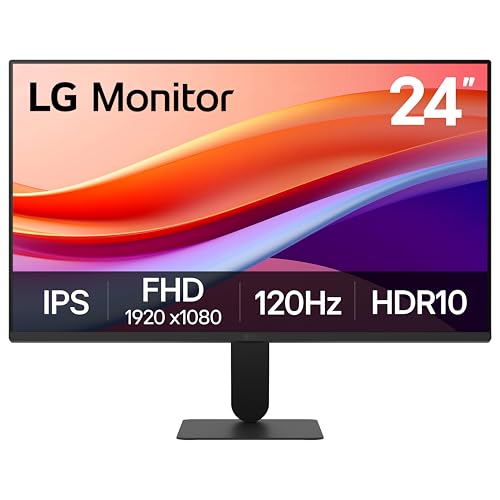
LG 24-Inch 120Hz IPS Monitor
Best for: compact 120Hz desktop productivity and light gaming
- Refresh Rate
- 120Hz
- Screen Size
- 24"
- Resolution
- 1920 x 1080
- Panel Type
- IPS
- Response Time
- 1ms MBR
- Connectivity
- HDMI
This LG display is a 24-inch Full HD monitor featuring an IPS panel and a 120Hz refresh rate. It pairs 1920 x 1080 resolution with up to 99% sRGB color gamut coverage and HDR10 support. With 1ms Motion Blur Reduction and Dynamic Action Sync, it reduces input lag and motion blur. This monitor suits you if you need a compact, fluid 120Hz screen for general productivity, daily multitasking, and casual gaming.
Pros
- 120Hz refresh rate delivers fluid motion
- IPS panel covers up to 99% sRGB color gamut
- 1ms Motion Blur Reduction and Dynamic Action Sync minimize blur and lag
- Tilt-adjustable stand ranging from -5° to 20°
Cons
- Resolution is standard 1080p rather than ultrawide or 1440p
- Connectivity is limited to HDMI without DisplayPort
- Stand lacks height, swivel, or pivot adjustments
Good fit if
- You need a compact 24-inch 120Hz IPS display for mixed work and light gaming.
- You want wide viewing angles and up to 99% sRGB coverage for everyday color accuracy.
Skip if
- You want an ultrawide screen aspect ratio or higher pixel density than 1080p.
- You require DisplayPort inputs or an ergonomic stand with height adjustment.
Verdict: LG 24-Inch 120Hz IPS Monitor delivers smooth 120Hz motion and solid IPS color accuracy in a compact Full HD format. It is a dependable choice if you prioritize fluid everyday performance over ultrawide workspace or high pixel density.

KOORUI 22-Inch 120Hz VA Monitor
Best for: small desks needing high refresh rates
- Refresh Rate
- 120Hz
- Screen Size
- 22"
- Resolution
- 1920 x 1080
- Sync Technology
- Adaptive-Sync
- Connectivity
- HDMI, VGA
- Panel Type
- VA
This compact display brings a 120Hz refresh rate and a 1080p Full HD VA panel to your desk. With a 21.5-inch viewable screen, it delivers a high 4000:1 contrast ratio along with Adaptive-Sync support to reduce tearing. It works well if you need a high-refresh display for tight spaces, general office work, or legacy PCs that require a VGA port.
Pros
- 120Hz refresh rate with Adaptive-Sync
- High 4000:1 contrast ratio on a VA panel
- HDMI and VGA video inputs
- Standard 100 x 100mm VESA mounting support
Cons
- No DisplayPort or USB-C connectivity
- Stand offers tilt only, without height adjustment
- Small 21.5-inch viewable area
Good fit if
- You want a 120Hz display that fits on a compact desk.
- You need a legacy VGA input alongside standard HDMI.
- You want high contrast for reading text or watching video.
Skip if
- You need DisplayPort or direct USB-C input.
- You require an ultrawide screen or a display larger than 22 inches.
Verdict: KOORUI 22-Inch 120Hz VA Monitor delivers fluid 120Hz motion and deep contrast in a space-saving 21.5-inch form factor. It provides core productivity specs with HDMI and VGA ports, though it lacks modern DisplayPort inputs.

SANSUI 27-Inch 120Hz FHD Monitor
Best for: high-contrast everyday 120Hz computing and casual gaming
- Refresh Rate
- 120Hz
- Screen Size
- 27 Inch
- Resolution
- 1920 x 1080P
- Response Time
- OD 5ms
- Sync Technology
- Free Sync
- Connectivity
- HDMI, DP
This 27-inch display features a 120Hz refresh rate and a Full HD 1920 x 1080 resolution. It includes HDMI and DisplayPort inputs alongside FreeSync support for smooth frame delivery. You also get a 4000:1 contrast ratio, 300 nits brightness, and 110% sRGB gamut coverage. It suits you if you need a high-contrast 120Hz desktop screen for office tasks and gaming.
Pros
- 120Hz refresh rate with FreeSync support
- High 4000:1 static contrast ratio
- 110% sRGB color gamut with 300 nits brightness
- Includes both HDMI and DisplayPort inputs
Cons
- Lacks built-in speakers and an audio headphone jack
- Limited to 1080p Full HD resolution
- Stand provides tilt only without height adjustment
Good fit if
- You want a 120Hz display with a deep 4000:1 contrast ratio.
- You connect your PC via standard HDMI or DisplayPort cables.
- You plan to mount your monitor using a 100x100mm VESA bracket.
Skip if
- You need integrated audio speakers or a direct headphone out port.
- You require a sharper 1440p resolution or an ultrawide aspect ratio.
- You want a stand with built-in height or swivel adjustment.
Verdict: SANSUI 27-Inch 120Hz FHD Monitor pairs fluid 120Hz output with an impressive 4000:1 contrast ratio for everyday desktop tasks. Its complete lack of audio output means you must use external speakers or headphones connected directly to your PC.

MSI 34-Inch 120Hz UWQHD Ultrawide Monitor
Best for: UWQHD multitasking and 120Hz gaming
- Refresh Rate
- 120Hz
- Screen Size
- 34"
- Resolution
- 3440 x 1440
- Panel Type
- VA / IPS
- Aspect Ratio
- 21:9
- Response Time
- 1ms
This MSI 34-inch ultrawide display gives you a 3440 x 1440 UWQHD resolution with a 120Hz refresh rate and a 21:9 aspect ratio. It features a 1500:1 contrast ratio, Adaptive Sync support, and TÜV Rheinland certified eye-care tech. Connectivity includes HDMI 2.0b and DisplayPort 1.4a. It suits you if you need expansive screen real estate for multitasking or gaming without dropping below a smooth 120Hz refresh pace.
Pros
- 3440 x 1440 UWQHD resolution across a 21:9 panel
- 120Hz refresh rate with Adaptive Sync
- DisplayPort 1.4a and HDMI 2.0b with HDMI-CEC
- TÜV Rheinland certified Flicker Free and Low Blue Light
Cons
- Stand supports tilt only with no height adjustment
- No USB-C connectivity or integrated USB hub
Good fit if
- You need a 3440 x 1440 resolution at 120Hz for productivity or gaming.
- You want Adaptive Sync to eliminate tearing during fast motion.
- You plan to use a 100x100mm VESA arm for positioning.
Skip if
- You need built-in height or swivel ergonomic adjustments.
- You require single-cable USB-C display and power delivery.
Verdict: MSI 34-Inch 120Hz Ultrawide Monitor delivers a spacious 3440 x 1440 UWQHD display with smooth 120Hz motion and Adaptive Sync. Its tilt-only stand means you may want an aftermarket VESA arm for height adjustments.

ViewSonic 24-Inch 120Hz IPS Monitor
Best for: daisy-chained multi-monitor office setups
- Refresh Rate
- 120Hz
- Screen Size
- 24"
- Resolution
- 1920 x 1080
- Panel Type
- IPS
- Connectivity
- HDMI, DisplayPort
- Size
- 24 Inch
If you need a compact screen with fluid motion, the ViewSonic 24-Inch 120Hz IPS Monitor provides a standard 1080p resolution on a 24-inch SuperClear IPS panel. Its 120Hz refresh rate delivers smoother movement than standard 60Hz displays. Integrated DisplayPort daisy-chain capability lets you link multiple monitors directly together. It suits you if you want a dual-screen productivity setup with flicker-free viewing and hardware blue light filtering.
Pros
- 120Hz refresh rate for smooth visual output
- SuperClear IPS panel with wide viewing angles
- DisplayPort-out daisy chain capability for multi-monitor desks
- Built-in Flicker-Free technology and Blue Light Filter
Cons
- Standard 16:9 aspect ratio rather than an ultrawide format
- 1080p resolution offers limited screen space compared to 1440p or 4K
- No USB Type-C connectivity listed
Good fit if
- You want a 120Hz 1080p IPS screen for daily office tasks.
- You plan to daisy-chain monitors using DisplayPort.
- You prioritize eye care features like flicker-free backlighting.
Skip if
- You want a true 21:9 ultrawide desktop workspace.
- You need higher display resolution such as 1440p or 4K.
Verdict: ViewSonic 24-Inch 120Hz IPS Monitor delivers fluid 120Hz motion and DisplayPort daisy-chain connectivity on a compact 1080p panel. It serves reliable multi-screen setups where standard proportions fit best.

Amzfast 49-Inch 120Hz DQHD Curved Monitor
Best for: dual-source multitasking and immersive super-ultrawide gaming
- Refresh Rate
- 120Hz
- Screen Size
- 49"
- Resolution
- 5120 x 1440
- Response Time
- 1ms MPRT
- Sync Technology
- Adaptive Sync
- Connectivity
- 2 x HDMI 2.0, 2 x DP 1.4
The Amzfast 49-Inch Curved 120Hz DQHD Monitor is a super-ultrawide 32:9 display built around a 1500R curved VA panel. It delivers a 5120x1440 resolution at a 120Hz refresh rate over DisplayPort 1.4, matching two side-by-side QHD screens without bezels. With picture-in-picture and picture-by-picture modes plus 350 nits of brightness, it suits you if you juggle dual inputs or need expansive horizontal screen space for immersive gaming and heavy multitasking.
Pros
- Dual QHD 5120x1440 resolution on an expansive 32:9 panel
- 120Hz refresh rate with Adaptive Sync and 1ms MPRT
- Built-in PIP and PBP modes for dual-signal split screen
- Ergonomic stand with height, tilt, and swivel adjustments
Cons
- 120Hz refresh rate is supported only through DisplayPort 1.4
- HDMI inputs are limited to older HDMI 2.0 standards
- Substantial desk footprint spanning 46.69 inches wide and over 24 pounds
Good fit if
- You want a single seamless 32:9 display to replace dual 1440p monitors.
- You work with two separate computer systems simultaneously using PBP.
- You prioritize an immersive 1500R curvature for wide-field gaming.
Skip if
- You plan to run 120Hz refresh rates exclusively over HDMI connections.
- You have a shallow or narrow desk that cannot fit a 46-inch wide chassis.
Verdict: Amzfast 49-Inch Curved 120Hz DQHD Monitor delivers expansive 32:9 screen real estate with smooth 120Hz DisplayPort performance. It is a solid dual-QHD replacement for users wanting hardware split-screen multitasking without center bezels.

Amzfast 32-Inch Curved 4K 120Hz Monitor
Best for: console and PC gaming with split-screen multitasking
- Refresh Rate
- 120Hz
- Screen Size
- 32"
- Resolution
- 3840x2160
- Sync Technology
- Adaptive Sync, VRR
- Connectivity
- HDMI 2.1, DP 1.4, audio jack
- Size
- 32 Inch
The Amzfast 32-Inch 4K 120Hz Curved Monitor pairs a 3840x2160 UHD resolution with a 120Hz refresh rate. It delivers dual HDMI 2.1 ports with VRR alongside DisplayPort 1.4, making it suitable if you connect gaming consoles or PCs. You also get a 3000:1 contrast ratio, 131% sRGB area coverage, integrated 3W speakers, and PIP/PBP support for handling two video inputs simultaneously on one curved display.
Pros
- 3840x2160 4K UHD resolution at 120Hz
- Dual HDMI 2.1 ports with VRR support
- High 3000:1 static contrast ratio
- Hardware PIP and PBP split-screen modes
Cons
- Moderate 300-nit maximum brightness
- Limited to 8-bit color depth (16.7M colors)
- Uses 75x75mm VESA mounting pattern instead of standard 100x100mm
Good fit if
- You need 4K resolution at 120Hz via HDMI 2.1 or DisplayPort 1.4.
- You want picture-in-picture or picture-by-picture to display two video inputs.
- You prefer a curved 32-inch screen with a high 3000:1 static contrast.
Skip if
- You require 10-bit color processing for color-critical production work.
- You need high peak brightness exceeding 300 nits.
- You use a standard 100x100mm VESA monitor arm without an adapter plate.
Verdict: Amzfast 32-Inch 4K 120Hz Curved Monitor delivers sharp 4K visuals, high static contrast, and HDMI 2.1 connectivity for multi-source setups. Its 300-nit brightness and 8-bit color limit its suitability for professional HDR mastering.

BenQ 27-Inch 120Hz IPS Monitor
Best for: daily office work requiring certified eye care
- Refresh Rate
- 120Hz
- Screen Size
- 27"
- Resolution
- 1080p
- Panel Type
- IPS
- Dimensions
- 24.3 × 7.2 × 17.9 inches
This BenQ display pairs a 27-inch IPS panel with a 120Hz refresh rate and 1080p resolution. You get wide viewing angles, 99% sRGB color coverage, and TÜV-certified low blue light and flicker-free hardware. The faster refresh rate delivers smoother movement than standard 60Hz office screens. It fits you if you want a fluid, color-accurate display for everyday office tasks and extended viewing sessions without eye fatigue.
Pros
- 120Hz refresh rate provides smooth motion
- IPS panel with 99% sRGB color coverage
- TÜV-certified Eye Comfort and Eyesafe 2.0 hardware
- Ultrathin bezel design
Cons
- 1080p resolution offers lower pixel density across 27 inches
- Standard 16:9 aspect ratio rather than an ultrawide workspace
Good fit if
- You need a 120Hz refresh rate for smoother desktop navigation.
- You want an IPS panel with 99% sRGB coverage for color work.
- You prioritize certified low-blue-light and flicker-free viewing features.
Skip if
- You require an ultrawide 21:9 or 32:9 workspace.
- You want higher resolution than 1080p on a 27-inch screen.
Verdict: BenQ 27-Inch 120Hz IPS Monitor brings smooth refresh rates and certified eye-care features to a standard full HD desktop setup. It provides reliable color reproduction and fluid motion for daily work.

ASUS 24-Inch 1080p 120Hz IPS Monitor
Best for: compact 1080p 120Hz multi-port desktop setups
- Refresh Rate
- 120Hz
- Screen Size
- 24"
- Resolution
- 1080p
- Panel Type
- IPS
- Response Time
- 1ms MPRT
- Sync Technology
- Adaptive-Sync
This ASUS 24-inch monitor features a 1080p Full HD IPS panel running at a 120Hz refresh rate. It pairs a 1ms MPRT response time with Adaptive-Sync to keep motion smooth. Connectivity options include DisplayPort, HDMI, and legacy VGA ports, alongside integrated speakers and VESA mount support. If you want a compact display for basic productivity and everyday gaming without high hardware demands, this setup fits your desk.
Pros
- 120Hz refresh rate with 1ms MPRT and Adaptive-Sync
- IPS panel with 99% sRGB coverage and 178-degree viewing angles
- DisplayPort, HDMI, and VGA video inputs
- Built-in speakers and VESA mount capability
Cons
- Standard 16:9 aspect ratio rather than ultrawide
- 1080p resolution provides limited desktop area compared to 1440p or 4K
Good fit if
- You need a compact 24-inch 120Hz display with both legacy VGA and modern DisplayPort inputs.
- You want built-in speakers and VESA compatibility for a standard desk setup.
Skip if
- You require an ultrawide aspect ratio for expansive multitasking.
- You prefer higher resolutions such as 1440p or 4K for greater visual detail.
Verdict: ASUS 24-Inch 1080p 120Hz IPS Monitor delivers smooth motion and versatile connectivity in a compact, standard-format chassis. It provides dependable baseline specs for desktop tasks and casual gaming.

Dell 32-Inch 4K QD-OLED Monitor
Best for: high-resolution QD-OLED performance and laptop docking
- Refresh Rate
- 120Hz
- Screen Size
- 31.6"
- Resolution
- 4K
- Panel Type
- QD-OLED
- Response Time
- 0.03ms
- Sync Technology
- AMD FreeSync Premium Pro
This 31.6-inch display pairs a 4K UHD QD-OLED panel with a 120Hz refresh rate and a 0.03ms response time. You get 99% DCI-P3 color coverage, VESA DisplayHDR True Black 400, and AMD FreeSync Premium Pro for smooth visuals. It includes integrated 5x5W speakers with 3D spatial audio and a USB-C port supplying 90W power delivery. It suits you if you need high-resolution color precision, fast pixel response, and single-cable laptop docking.
Pros
- 4K UHD QD-OLED panel with an ultra-low 0.03ms response time
- Single USB-C connection with up to 90W power delivery
- 99% DCI-P3 color gamut with Dolby Vision and DisplayHDR True Black 400
- AMD FreeSync Premium Pro variable refresh rate up to 120Hz
- Integrated 5x5W speakers with AI-driven spatial audio and head-tracking
Cons
- Heavy build weighing 22.05 pounds
- Pop-out quick-access USB-C port is capped at 15W power delivery
Good fit if
- You want 4K QD-OLED visuals with near-instantaneous 0.03ms pixel response times.
- You need 90W USB-C power delivery to charge your laptop through a single cable.
- You require wide color coverage covering 99% of the DCI-P3 space.
Skip if
- You need a lightweight display that weighs under 22.05 pounds.
- You require more than 15W of power from the quick-access front ports.
Verdict: Dell 32-Inch 4K QD-OLED Monitor delivers precise 4K clarity, rapid 0.03ms response performance, and clean 90W USB-C connectivity for high-end setups.
Specifications side by side
| Spec | Philips 22-Inch 120Hz IPS Monitor | Dell 32-Inch 4K 120Hz Monitor | Acer 23.8-Inch 120Hz IPS Monitor | SANSUI 27-Inch Curved 120Hz USB-C Monitor | Philips 27-Inch 120Hz IPS Monitor | LG 24-Inch 120Hz IPS Monitor | KOORUI 22-Inch 120Hz VA Monitor | SANSUI 27-Inch 120Hz FHD Monitor | MSI 34-Inch 120Hz UWQHD Ultrawide Monitor | ViewSonic 24-Inch 120Hz IPS Monitor | Amzfast 49-Inch 120Hz DQHD Curved Monitor | Amzfast 32-Inch Curved 4K 120Hz Monitor | BenQ 27-Inch 120Hz IPS Monitor | ASUS 24-Inch 1080p 120Hz IPS Monitor | Dell 32-Inch 4K QD-OLED Monitor |
|---|---|---|---|---|---|---|---|---|---|---|---|---|---|---|---|
| Screen Size | 22" | 32 | 23.8" | 27 inch | 27 Inch | 24" | 22" | 27 Inch | 34" | 24" | 49" | 32" | 27" | 24" | 31.6" |
| Resolution | 1920 x 1080 | 4K UHD | 1920 x 1080 | not specified | 1920x1080 | 1920 x 1080 | 1920 x 1080 | 1920 x 1080P | 3440 x 1440 | 1920 x 1080 | 5120 x 1440 | 3840x2160 | 1080p | 1080p | 4K |
| Refresh Rate | 120Hz | 120Hz | 120Hz | 120Hz | 120Hz | 120Hz | 120Hz | 120Hz | 120Hz | 120Hz | 120Hz | 120Hz | 120Hz | 120Hz | 120Hz |
| Panel Type | IPS | not specified | IPS | not specified | IPS | IPS | not specified | not specified | VA / IPS | IPS | not specified | not specified | IPS | IPS | QD-OLED |
| Aspect Ratio | not specified | not specified | 16:9 | not specified | not specified | not specified | not specified | not specified | 21:9 | not specified | not specified | not specified | not specified | not specified | not specified |
| Response Time | 1ms MPRT | 0.03ms | 1ms VRB | 1ms (MPRT) | not specified | 1ms MBR | not specified | OD 5ms | 1ms | not specified | 1ms MPRT | not specified | not specified | 1ms MPRT | 0.03ms |
| Sync Technology | Adaptive-Sync | AMD FreeSync Premium | Adaptive-Sync | Adaptive Sync | not specified | not specified | Adaptive-Sync | Free Sync | Adaptive-Sync (FreeSync compatible) | not specified | Adaptive Sync | Adaptive Sync, VRR | not specified | Adaptive-Sync | AMD FreeSync Premium Pro |
| Connectivity | HDMI | not specified | not specified | USB Type-C, HDMI 1.4 | HDMI, DisplayPort, VGA | HDMI | HDMI, VGA | HDMI, DP | HDMI 2.0b, DisplayPort 1.4a | HDMI, DisplayPort | 2 x HDMI 2.0, 2 x DP 1.4 | HDMI 2.1, DP 1.4, audio jack | not specified | HDMI, DisplayPort, VGA | USB-C |
| Size | 22 inch 120Hz | S3225QS | 23.8-inch | 26.998 | 27 inch 120Hz | 24 Inch | 22 | 27.001 | not specified | 24 Inch | 49 Inch | 32 Inch | not specified | 24 Inch | S3225QC |
| Dimensions | 6.7 × 19.5 × 15 inches | 8.73 × 28.1 × 17.6 inches | 4.53 × 21.2 × 16.7 inches | 8.31 × 24.1 × 17.9 inches | 1.3 × 14.1 × 24.3 inches | 8.7 × 21.2 × 16.4 inches | 15.4 × 19.3 × 7.09 inches | 7.76 × 24.1 × 17.9 inches | 18.5 × 31.9 × 9.33 inches | 7.8 × 21.2 × 15.4 inches | 11.6 × 46.7 × 22.3 inches | 7.48 × 28.2 × 20.1 inches | 24.3 × 7.2 × 17.9 inches | 7.4 × 21.3 × 16 inches | 8.81 × 28.3 × 19.8 inches |
| Weight | 4.48 pounds | 19.3 pounds | not specified | 10 pounds | 12 pounds | 7.1 pounds | 5 pounds | not specified | 24.5 pounds | 6.8 pounds | 24.1 pounds | not specified | not specified | 6.7 pounds | 22.1 pounds |
| Color | Black | Ash White | Black | Black | Black | Black | Black | Black | Black | Black | Black | Black | Black | BLACK | Ash White |
| Model | 22E2N1100 | S3225QS | UM.QK2AA.003 | ES-27C1 | 27E2N2100 | 24U411A-B.AUSQ | E2212H | ES-27F2 | PRO MP341CQ E12 | VA2456A-MHD | AMZG49C7U | AMZG32C3U | GW2790P | VA249QG | S3225QC |
Is a 120Hz refresh rate worth it?
A 120Hz refresh rate displays 120 frames every second to deliver fluid on-screen motion. In daily use, this spec provides smooth visual tracking for office productivity, multimedia workflows, and gaming. Compatible displays pair 120Hz with Adaptive Sync or FreeSync to maintain steady frame pacing across HDMI, DisplayPort, and USB-C connections. You find 120Hz across compact 22-inch 1080p screens, wide 34-inch UWQHD panels, 49-inch DQHD setups, and 4K displays. The higher refresh rate keeps movement clear whether you navigate standard documents or view fast-moving visual content.
Worth it if
- You want fluid motion and steady frame pacing supported by FreeSync or Adaptive Sync.
- You plan to connect via HDMI, DisplayPort, or USB-C to drive 120Hz output.
- You want smooth visual performance across 1080p, UWQHD, DQHD, or 4K resolutions.
Skip it if
- You prioritize ultrawide workspace or higher pixel density over fluid refresh rates.
- You use basic video hardware that cannot output 120Hz signals over modern display ports.
If you need a compact second screen rather than a stationary desktop panel, you can compare a portable monitor with HDMI instead.
How We Picked 120Hz Monitors
To select the 15 monitors in this guide, you find displays identified by a 120Hz refresh rate stated in their Amazon listing title or feature list. Every included model matches this specific refresh rate. Only one size or variant from each product family is featured, keeping the comparison focused on distinct options.
The guide lists products in stock first, then by Amazon sales rank (better-selling products first). Additional specifications used to compare these displays include screen size, resolution, panel type, and ports like HDMI, DisplayPort, and USB-C. All details come strictly from published manufacturer specifications without physical handling.
How to Choose the Right 120Hz Monitor
-
Select Your Panel Technology
IPS, VA, and QD-OLED panels offer distinct visual characteristics. IPS panels provide wider viewing angles and accurate color reproduction, making them reliable for general desktop tasks. VA panels increase static contrast ratios up to 4000:1 for deeper black levels in dark environments. For premium color output and immediate pixel transitions, QD-OLED panels deliver near-instantaneous speeds. If you need maximum pixel clarity and a rapid 0.03ms response time, check specifications like those on the Dell 32-Inch 4K QD-OLED Monitor.
-
Verify Desk Space and Weight
Before purchasing an ultrawide or large display, measure your desk depth and surface width. Large ultrawide screens require substantial desktop surface area and sturdy support arms. For instance, the Amzfast 49-Inch 120Hz DQHD Curved Monitor spans 46.69 inches wide and weighs over 24 pounds. If your desk is shallow, a screen with a deep stand base pushes the display uncomfortably close to your seating position. Review product dimension and weight listings to verify that your desk frame or monitor arm safely supports the display.
-
Check Display Port Connectivity
Evaluate the connection ports on your computer before picking a monitor input configuration. Standard HDMI ports work for most desktop systems, but laptops frequently benefit from USB-C video input to simplify setup cabling. If you dock a laptop regularly, choose a display featuring USB-C support. The SANSUI 27-Inch Curved 120Hz USB-C Monitor incorporates a dedicated USB-C port, allowing direct video transmission over a single cable. If you use legacy desktop computers, check for older video ports like VGA alongside modern DisplayPort and HDMI jacks.
-
Review Integrated Audio Hardware
Audio hardware configurations vary widely across 120Hz displays. Some models integrate built-in speakers for basic system notifications and media playback without external equipment on your desk. However, other models omit sound output entirely. For example, the SANSUI 27-Inch 120Hz FHD Monitor lacks onboard audio hardware, requiring you to plug speakers or headphones directly into your desktop computer. If you want clean desk space without auxiliary desktop speakers, verify whether the specifications list integrated speakers, an audio pass-through jack, or no sound capabilities at all.
-
Examine Stand Adjustment Capabilities
Ergonomic adjustability determines whether you can align your screen properly with your eye level. Factory monitor stands range from multi-directional adjustment brackets to basic fixed pedestals. The MSI 34-Inch 120Hz UWQHD Ultrawide Monitor includes a tilt-only stand, meaning you cannot adjust panel height or rotate the display without an aftermarket arm. If your workstation requires height adjustments for neck comfort, look for a screen with full height articulation or confirm that the monitor supports standard VESA mounting patterns so you can install an adjustable monitor arm.
-
Consider Multi-Monitor Daisy Chaining
If you plan to run a multi-display workstation, check whether the monitor supports DisplayPort daisy chaining. Daisy chaining lets you connect one cable from your PC to the primary screen and a second cable directly between monitors. The ViewSonic 24-Inch 120Hz IPS Monitor supports DisplayPort daisy chaining, reducing cable clutter across your workspace. Without this hardware capability, each monitor must run an individual video cable directly back to your graphics card or laptop dock, which requires multiple available video output ports on your host computer.
Frequently asked questions
What cable do you need to run a 120Hz ultrawide monitor?
You need a DisplayPort cable, a compatible HDMI cable, or a supported USB-C video connection. Bandwidth demands grow as resolution increases. Models like the MSI 34-Inch ultrawide feature DisplayPort and HDMI to handle 3440 x 1440 resolution at 120Hz. For 32:9 super-ultrawide screens such as the Amzfast 49-inch at 5120 x 1440, DisplayPort connections provide the necessary data bandwidth for full refresh rates.
Can you daisy chain multiple 120Hz monitors together?
You can daisy chain monitors if the display includes a dedicated DisplayPort Out connection. For example, the ViewSonic 24-Inch IPS monitor supports DisplayPort daisy-chain setups for multi-screen arrangements. Your system's graphics card must supply sufficient bandwidth over the main cable to drive both displays at 120Hz. Most standard monitors lack this secondary output port and require direct graphics card connections.
Does a 120Hz ultrawide monitor work for console gaming?
Yes, modern consoles support 120Hz output, but they do not support ultrawide aspect ratios. Current game consoles output video in standard 16:9 formats. If you connect an ultrawide display like the MSI 34-inch or Amzfast 49-inch, you will see black pillarbox borders on the sides. Standard displays like the Dell 32-Inch 4K monitor accept console 120Hz signals without altering frame proportions.
What is the difference between VA and QD-OLED panels at 120Hz?
VA panels use LED backlighting to produce high contrast, whereas QD-OLED panels utilize self-emissive pixels for faster transitions. The Dell 32-Inch QD-OLED monitor offers an ultra-fast 0.03ms response time with per-pixel lighting control. In contrast, VA options like the MSI 34-Inch Ultrawide monitor produce high native contrast ratios, but liquid crystal transitions take longer than self-emissive organic diodes during fast motion.
Can you charge a laptop while outputting video to a 120Hz monitor?
Yes, you can charge your laptop if the monitor supports USB Power Delivery over USB-C. For instance, the Dell 32-Inch 4K QD-OLED monitor supplies up to 90W of power over its USB-C connection while carrying video signals. Other displays like the SANSUI 27-Inch Curved offer USB-C video input but do not specify power delivery, requiring a separate laptop charger.
Can you display two different computers simultaneously on a super-ultrawide monitor?
Yes, you can display two separate computers if the monitor supports multi-source hardware splitting. The Amzfast 49-Inch DQHD monitor includes dual-source multitasking support across its 32:9 panel. It receives simultaneous inputs via DisplayPort and HDMI, letting you view two systems side by side on one screen without any physical center bezel separating the 5120 x 1440 desktop workspace.
Do 120Hz monitors come with built-in speakers?
Some 120Hz monitors feature integrated speakers, while other models omit internal audio hardware entirely. For example, the SANSUI 27-Inch Curved monitor includes built-in speakers for immediate desktop audio playback. In contrast, the SANSUI 27-Inch FHD monitor features no audio output ports, meaning you must route your sound through external speakers or headphones connected directly to your computer.