5 Best Ultrawide Monitors Under $1000, Compared
As an Amazon Associate we earn from qualifying purchases. Links on this page are affiliate links.
Finding the ideal ultrawide monitor under 1000 requires balancing resolution, refresh rate, and panel performance for your workspace. We compared 5 monitors using only the verified specifications published on their official product listings.
The ASUS 32-Inch 4K QD-OLED Gaming Monitor earns the top recommendation because it delivers a sharp 4K UHD resolution paired with a 240Hz QD-OLED panel. This guide helps you decide which screen size, panel type, and refresh rate best match your desk setup and gaming preferences.
Quick picks
| # | Product | Best for | Price |
|---|---|---|---|
| 1 | ASUS 32-Inch 4K QD-OLED Gaming Monitor Also great | high-refresh 4K gaming with precise OLED colors | Check price of ASUS 32-Inch 4K QD-OLED Gaming Monitor on Amazon |
| 2 | Samsung 49-inch Odyssey QD-OLED Gaming Monitor Best premium | fast-paced ultrawide gaming on a massive scale | Check price of Samsung 49-inch Odyssey QD-OLED Gaming Monitor on Amazon |
| 3 | BenQ 24-Inch 600Hz Fast TN Gaming Monitor Also great | competitive esports players needing maximum refresh rates | Check price of BenQ 24-Inch 600Hz Fast TN Gaming Monitor on Amazon |
| 4 | MSI 32-Inch Curved 4K QD-OLED Monitor Also great | curved 4K 240Hz QD-OLED gaming setups | Check price of MSI 32-Inch Curved 4K QD-OLED Monitor on Amazon |
| 5 | Dell 32-Inch 4K 120Hz Thunderbolt Monitor Also great | Dual-system creative work and laptop docking | Check price of Dell 32-Inch 4K 120Hz Thunderbolt Monitor on Amazon |
The best fit for you
- You want 4K resolution paired with fast refresh rates ASUS 32-Inch 4K QD-OLED Gaming Monitor Its 32-inch 4K UHD QD-OLED panel pairs a 240Hz refresh rate with G-SYNC support.
- You want an ultrawide screen for expansive gaming setups Samsung 49-inch Odyssey QD-OLED Gaming Monitor The 49-inch curved QD-OLED panel provides an ultrawide canvas with a 240Hz refresh rate.
- You need maximum refresh rates for competitive esports gaming BenQ 24-Inch 600Hz Fast TN Gaming Monitor A 600Hz Fast TN panel with DyAc 2 technology maximizes motion clarity for competitive play.
- You need a display for dual-system creative laptop docking Dell 32-Inch 4K 120Hz Thunderbolt Monitor Its 4K UHD resolution and Enhanced IPS Black panel support single-cable docking via Thunderbolt.
Our 5 picks

ASUS 32-Inch 4K QD-OLED Gaming Monitor
Best for: high-refresh 4K gaming with precise OLED colors
- Screen Size
- 32-inch
- Resolution
- 3840 x 2160
- Refresh Rate
- 240 Hz
- Panel Type
- QD-OLED
- Response Time
- 0.03 ms GTG
- Sync Technology
- G-SYNC Compatible
This display is a 32-inch 4K QD-OLED monitor pairing a 3840 x 2160 resolution with a 240 Hz refresh rate and a 0.03 ms response time. You get G-SYNC compatibility, 99% DCI-P3 color coverage, and 90W USB-C power delivery for single-cable setups. It suits you if you prioritize high-density 4K visuals, fast pixel response, and OLED color accuracy over an ultrawide aspect ratio.
Pros
- 240 Hz refresh rate with 0.03 ms GTG response time
- 99% DCI-P3 gamut and true 10-bit color support
- 90W USB-C power delivery for data and device charging
- Three-year warranty includes burn-in coverage
Cons
- Standard 16:9 aspect ratio rather than an ultrawide screen format
- DisplayHDR 400 True Black rating rather than higher peak luminance tiers
Good fit if
- You want a 240 Hz 4K QD-OLED panel with 0.03 ms response times.
- You need 90W USB-C connectivity to charge and run an external machine.
- You require factory color precision with Delta E under 2.
Skip if
- You require a 21:9 or 32:9 ultrawide horizontal aspect ratio.
- You prefer a curved screen over a flat panel.
Verdict: ASUS 32-Inch 4K QD-OLED Gaming Monitor delivers ultra-fast 240 Hz 4K imagery and 90W USB-C power in a standard 16:9 form factor. It provides top-tier color accuracy and burn-in warranty protection for users prioritizing pixel density over ultrawide width.

Samsung 49-inch Odyssey QD-OLED Gaming Monitor
Best for: fast-paced ultrawide gaming on a massive scale
- Screen Size
- 49"
- Refresh Rate
- 240Hz
- Panel Type
- QD-OLED
- Response Time
- 0.03ms (GTG)
- Sync Technology
- G-Sync Compatible
- Connectivity
- HDMI 2.1, DisplayPort, USB
View on Amazon: Samsung 49-inch Odyssey QD-OLED Gaming Monitor
This 49-inch curved monitor combines a QD-OLED panel with a 240Hz refresh rate and an 1800R curve. You get a rapid 0.03ms gray-to-gray response time, DisplayHDR True Black 400 support, and G-Sync compatibility. Connectivity includes DisplayPort, HDMI 2.1, and an integrated USB hub. It suits you if you want a massive ultrawide display for fast-paced gaming where motion clarity and deep black levels are critical.
Pros
- 49-inch QD-OLED panel with DisplayHDR True Black 400
- 240Hz refresh rate and 0.03ms GTG response time
- G-Sync compatible with Auto Source Switch plus
- HDMI 2.1, DisplayPort, and USB hub connectivity
Cons
- Substantial footprint requiring 47.1 inches of horizontal desk space
- Heavy display weighing 27.8 pounds
Good fit if
- You want a 49-inch QD-OLED display with a 240Hz refresh rate.
- You need near-instant 0.03ms pixel response times for fast action.
- You have sufficient desk width to accommodate a 47.1-inch wide frame.
Skip if
- You have a compact desk that cannot support a 47.1-inch wide, 27.8-pound monitor.
- You prefer a tighter screen curve than the 1800R radius.
Verdict: Samsung 49-Inch Curved QD-OLED Gaming Monitor delivers ultra-fast 240Hz motion and deep contrast across a massive 49-inch canvas. Its sheer size and weight require significant desk space, but the visual specs excel for high-speed play.

BenQ 24-Inch 600Hz Fast TN Gaming Monitor
Best for: competitive esports players needing maximum refresh rates
- Screen Size
- 24.1
- Resolution
- FHD
- Refresh Rate
- 600Hz
- Panel Type
- Fast TN
- Dimensions
- 22.7 × 8.2 × 20.4 inches
- Weight
- 25 pounds
This BenQ display is a 24.1-inch esports monitor built with a Fast TN panel and a 600Hz refresh rate. While not an ultrawide screen, it delivers native FHD resolution alongside DyAc 2 dual-backlight blur reduction and an integrated vivid color film. If you prioritize competitive motion clarity and maximum frame rates over expansive horizontal desktop space or ultrawide aspect ratios, this compact black display suits your desk setup.
Pros
- 600Hz refresh rate for high frame output
- DyAc 2 dual backlight blur reduction technology
- Fast TN panel engineered to reduce pixel overshoot
- Vivid color film with 35% improved color performance over standard TN panels
Cons
- Standard 24.1-inch 16:9 screen lacks ultrawide field of view
- Native FHD resolution provides lower detail than 1440p or 4K panels
- Heavy 25-pound overall weight
Good fit if
- You want a 600Hz refresh rate for esports titles.
- You prioritize DyAc 2 blur reduction over screen width.
- You specifically play at native FHD resolution.
Skip if
- You need an ultrawide 21:9 or 32:9 aspect ratio.
- You require 1440p or 4K resolution for sharp detail.
- You want an IPS or OLED panel instead of Fast TN.
Verdict: BenQ 24-Inch 600Hz Fast TN Gaming Monitor delivers extreme 600Hz speed and DyAc 2 motion clarity for competitive play. It trades ultrawide screen real estate and higher resolution for liquid crystal response speed.
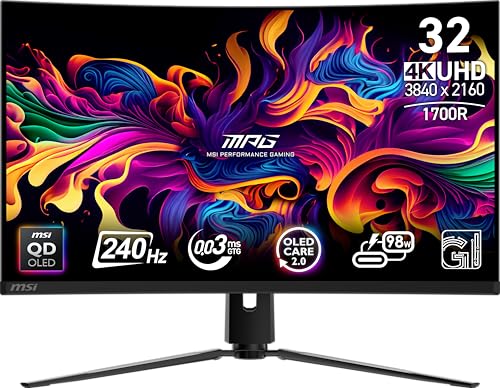
MSI 32-Inch Curved 4K QD-OLED Monitor
Best for: curved 4K 240Hz QD-OLED gaming setups
- Screen Size
- 32"
- Refresh Rate
- 240Hz
- Panel Type
- QD-OLED
- Response Time
- 0.03ms GTG
- Sync Technology
- G-SYNC Compatible
- Connectivity
- HDMI 2.1, DP 1.4a, USB C (98W PD)
The MSI 32-Inch Curved 4K QD-OLED Monitor provides a 3840x2160 resolution across a curved 1700R panel. It features a 240Hz refresh rate alongside a 0.03ms gray-to-gray response time for fast visual output. With built-in KVM switching, 98W USB-C power delivery, and full-bandwidth HDMI 2.1 ports, you can connect multiple machines easily. It suits you if you prioritize sharp 4K detail and high-speed OLED performance over an ultrawide aspect ratio.
Pros
- 240Hz refresh rate and 0.03ms GtG response time
- 3840x2160 4K QD-OLED panel with 1700R curvature
- USB-C port with 98W power delivery and built-in KVM switch
- Console Mode HDMI 2.1 inputs with full 48 Gbps bandwidth
Cons
- Standard 16:9 aspect ratio rather than an ultrawide format
- Total weight reaches 27.1 pounds
- DisplayHDR True Black 400 specification rather than higher HDR tiers
Good fit if
- You want 4K UHD resolution paired with a 240Hz QD-OLED panel.
- You need 98W USB-C power delivery and a KVM switch to share peripherals across systems.
- You prefer a subtle 1700R curve on a 32-inch screen.
Skip if
- You want a true 21:9 or 32:9 ultrawide aspect ratio instead of standard 16:9.
- You need a lightweight display for standard monitor arms, as this unit weighs 27.1 pounds.
Verdict: MSI 32-Inch Curved 4K QD-OLED Monitor delivers high-end speed with its 240Hz refresh rate, 0.03ms response time, and 4K QD-OLED panel. It is a capable choice if you prefer higher vertical pixel density and desktop versatility over an ultrawide canvas.

Dell 32-Inch 4K 120Hz Thunderbolt Monitor
Best for: Dual-system creative work and laptop docking
- Resolution
- 4K UHD
- Refresh Rate
- 120 Hz
- Panel Type
- Enhanced IPS Black
- Connectivity
- Thunderbolt, Ethernet
- Dimensions
- 8.46 × 28.1 × 18.5 inches
- Weight
- 20.6 pounds
This Dell UltraSharp display gives you a 32-inch 4K UHD workspace built on an Enhanced IPS Black panel. It runs at a 120 Hz refresh rate and delivers a 3,000:1 contrast ratio with 99 percent Display P3 coverage. With built-in Thunderbolt connectivity, fast Ethernet, and an integrated KVM switch, it suits you if you dock a laptop and share peripherals between two computers.
Pros
- Enhanced IPS Black panel with a 3,000:1 contrast ratio
- 99% Display P3 coverage and factory calibration at Delta E less than 1.5
- Built-in KVM switch to share peripherals across two computers
- Thunderbolt connectivity with integrated fast Ethernet port
Cons
- Refresh rate tops out at 120 Hz
- No integrated audio speakers listed in the specifications
Good fit if
- You need color-critical accuracy with 99% Display P3 coverage and low Delta E.
- You work across two computers and want to switch inputs using one keyboard and mouse.
- You connect via Thunderbolt and need wired Ethernet directly through your display.
Skip if
- You want a dedicated gaming monitor with refresh rates exceeding 120 Hz.
- You need built-in audio speakers directly on your monitor.
Verdict: Dell UltraSharp 32-Inch 4K Thunderbolt Monitor combines high color accuracy and an Enhanced IPS Black panel with integrated hub features. It provides a clean single-cable setup for professionals managing two systems.
Specifications side by side
| Spec | ASUS 32-Inch 4K QD-OLED Gaming Monitor | Samsung 49-inch Odyssey QD-OLED Gaming Monitor | BenQ 24-Inch 600Hz Fast TN Gaming Monitor | MSI 32-Inch Curved 4K QD-OLED Monitor | Dell 32-Inch 4K 120Hz Thunderbolt Monitor |
|---|---|---|---|---|---|
| Screen Size | 32-inch | 49" | 24.1 | 32" | not specified |
| Resolution | 3840 x 2160 | not specified | FHD | not specified | 4K UHD |
| Refresh Rate | 240 Hz | 240Hz | 600Hz | 240Hz | 120 Hz |
| Panel Type | QD-OLED | QD-OLED | Fast TN | QD-OLED | Enhanced IPS Black |
| Response Time | 0.03 ms GTG | 0.03ms (GTG) | not specified | 0.03ms GTG | not specified |
| Sync Technology | G-SYNC Compatible | G-Sync Compatible | not specified | G-SYNC Compatible | not specified |
| Connectivity | USB-C | HDMI 2.1, DisplayPort, USB | not specified | HDMI 2.1, DP 1.4a, USB C (98W PD) | Thunderbolt, Ethernet |
| Dimensions | 21 × 38 × 49 inches | 11.2 × 47.1 × 20.9 inches | 22.7 × 8.2 × 20.4 inches | 9.53 × 28.3 × 19 inches | 8.46 × 28.1 × 18.5 inches |
| Weight | 19.4 pounds | 27.8 pounds | 25 pounds | 27.1 pounds | 20.6 pounds |
| Size | 9.40 | 240Hz Refresh Rate | not specified | 32" | U3226QER |
| Color | BLACK | Aluminum Silver | Black | Black | Silver |
| Model | PG32UCDM | LS49CG932SNXZA | XL2586X+ | MPG 321CURX QD-OLED | U3226QER |
Specs You Trade Off Under $1000
Shoppers evaluating monitors Under $1000 encounter distinct specification compromises across different models. Choosing 4K UHD resolution restricts your refresh rate to 120Hz or 240Hz, while securing a 600Hz refresh rate requires moving to a 24-inch Fast TN panel. Ultrawide screen size is limited to one 49-inch unit, as the remaining options use 32-inch or 24-inch dimensions. Furthermore, productivity features like Thunderbolt connectivity remain confined to 120Hz panels, while dedicated gaming models focus strictly on DisplayPort, HDMI, or standard USB-C connections.
- Screen size: True ultrawide width is limited to a single 49-inch model, while others use standard 32-inch or 24-inch displays.
- Panel type: Reaching the highest refresh rates requires accepting a Fast TN panel instead of QD-OLED or IPS Black.
- Refresh rate: Choosing 4K UHD visual detail caps your speed at 240Hz or 120Hz instead of esports-grade 600Hz.
- Connectivity: Thunderbolt hub docking is reserved for productivity displays and omitted on high-refresh gaming options.
If you are planning an entire PC build, you can review specifications for a motherboard under 1000 to check expansion slot support.
How We Selected These Monitors
You see monitors selected strictly from published manufacturer specifications on Amazon listings that qualify as Under $1000. All details come directly from specifications and feature lists published on the listings without physical handling. To keep your comparison simple and direct, you see only one size or variant from each product family.
The guide arranges items with products in stock first, then by Amazon sales rank (better-selling products first). Live catalog details update at least daily to reflect current availability. Because inclusion depends on these continuous updates, monitors move in or out of this guide as listings shift relative to Under $1000.
Key Specifications to Check Before Buying
-
Selecting the Panel Technology
Check the panel type to match your primary visual requirements. QD-OLED panels deliver deep contrast and fast response, while Enhanced IPS Black options focus on stable color reproduction and clarity for daily productivity. Fast TN panels prioritize raw speed for fast frames over wide viewing angles. If you work on dual-system setups or office tasks, an Enhanced IPS Black screen like the Dell 32-Inch 4K 120Hz Thunderbolt Monitor offers steady viewing and high color accuracy. Compare panel specs before buying.
-
Matching Your Refresh Rate
Examine the refresh rate to align with your graphics hardware and target frame rates. Casual use and general productivity run smoothly at 120Hz, while standard gaming benefits from 240Hz. Competitive esports enthusiasts who prioritize fluid frame transitions over screen real estate need maximum speed. For example, the BenQ 24-Inch 600Hz Fast TN Gaming Monitor hits 600Hz to eliminate motion blur during fast motion. Verify that your system outputs high enough frame rates to take advantage of these elevated refresh specifications.
-
Verifying Ports and Power
Review the available inputs on the monitor to simplify your cable management. DisplayPort and HDMI carry high-bandwidth video signals, but built-in USB-C ports add extra utility for laptop owners. Look for USB-C connections that support video passthrough alongside device charging. The ASUS 32-Inch 4K QD-OLED Gaming Monitor supplies 90W USB-C power delivery, letting you charge a connected laptop through a single cord while transmitting video. Check port versions and wattage ratings to confirm compatibility with all your source devices.
-
Checking Variable Refresh Compatibility
Look for hardware variable refresh rate support to prevent screen tearing and stutter during gaming. Matching your graphics card to the display synchronization standard ensures frame delivery stays consistent even when framerates fluctuate under heavy graphical loads. Models like the MSI 32-Inch Curved 4K QD-OLED Monitor include G-SYNC technology to lock frame timing between your graphics processor and the screen. Confirm that your specific graphics card supports the exact synchronization protocols listed in the monitor specifications before completing your purchase.
-
Assessing Weight and Mounts
Evaluate total monitor weight before finalizing your setup, especially if you plan to install an aftermarket desk arm. Heavy screens place high mechanical stress on desk edges and standard VESA brackets. The Samsung 49-inch Odyssey QD-OLED Gaming Monitor weighs 27.8 pounds, which exceeds the weight capacity of many basic monitor mounts. Inspect your desk thickness, frame durability, and the weight rating of your mounting hardware against the official product specifications to prevent sagging or instability over time.
Frequently asked questions
How much desk space do you need for a 49-inch curved monitor?
You need at least 48 inches of clear desktop width to fit a 49-inch ultrawide monitor safely. The Samsung 49-inch Odyssey measures 47.1 inches wide and 11.2 inches deep. It weighs 27.8 pounds, meaning your desk surface or mounting arm must support substantial physical width and weight.
What response time can you expect from a 4K QD-OLED gaming monitor?
You can expect pixel response times as fast as 0.03 milliseconds on modern QD-OLED panels. The MSI MPG 321CURX lists this 0.03ms response time alongside its 240Hz refresh rate. These speeds minimize motion blur during fast gameplay, especially when paired with adaptive sync technologies like G-SYNC.
Can you power a laptop directly from a 4K monitor USB-C port?
Yes, compatible monitors provide high-wattage power through USB-C to charge laptops while carrying video signals. The ASUS PG32UCDM delivers up to 90W of power over its USB-C connection. This single-cable setup reduces cable clutter on your desk while driving a 4K UHD display at high refresh rates.
Why choose a Fast TN monitor over an OLED screen for gaming?
You choose a Fast TN panel when maximum refresh rate is your priority. The BenQ XL2586X+ reaches a 600Hz refresh rate and incorporates DyAc 2 motion clarity on a 24-inch display. While QD-OLED models top out at 240Hz, Fast TN targets liquid crystal response speed for competitive esports.
Which monitor features support working across two separate computers?
You should look for integrated Thunderbolt connectivity and built-in hub hardware to manage two computers on one screen. The Dell UltraSharp U3226QER features an integrated hub and Thunderbolt connectivity designed for dual-system creative setups. This setup allows you to dock a laptop alongside your primary workstation.
What video inputs are standard on high-refresh 4K gaming displays?
High-refresh 4K displays typically feature DisplayPort, HDMI, and USB-C ports to handle uncompressed display bandwidth. The MSI 32-inch curved QD-OLED monitor includes DisplayPort, HDMI, and USB-C ports to operate its 240Hz panel. These interfaces let you connect current graphics cards and external devices to achieve native 4K UHD output.
Are 32-inch 4K QD-OLED monitors curved or flat?
Manufacturers build 32-inch 4K QD-OLED monitors in both flat and curved designs. The MSI MPG 321CURX utilizes a curved screen profile, whereas the ASUS PG32UCDM features a standard flat form factor. Both designs provide 4K UHD resolution, 240Hz refresh rates, and G-SYNC compatibility.