Best Qd-OLED Ultrawide Monitors: 15 Spec-Based Picks
As an Amazon Associate we earn from qualifying purchases. Links on this page are affiliate links.
Selecting the best QD-OLED ultrawide monitors involves comparing resolution, panel size, and refresh rates across different form factors. This guide examines 15 products strictly using the specifications published on their listings.
The Alienware 27-Inch 4K QD-OLED Gaming Monitor takes the top spot because it combines a sharp 4K UHD resolution with a 240Hz refresh rate and a rapid 0.03ms response time. Reviewing these published attributes helps you choose the ideal balance of pixel density, screen width, and motion clarity for your desk setup.
Quick picks
The best fit for you
- You want 4K resolution with high refresh rates Alienware 27-Inch 4K QD-OLED Gaming Monitor It combines 4K UHD resolution with a 240Hz refresh rate and 0.03ms response time.
- You prioritize maximum refresh rate for competitive play Samsung Odyssey 27-Inch 360Hz QD-OLED Monitor Its QD-OLED panel reaches a 360Hz refresh rate alongside a 0.03ms response time.
- You want a curved ultrawide for immersive gaming Alienware 34-Inch Curved QD-OLED Monitor The 34-inch curved display delivers a 3440 x 1440 ultrawide resolution at 165Hz.
- You need maximum screen width for multitasking productivity Samsung 49-Inch Odyssey QD-OLED Gaming Monitor The 49-inch display delivers an expansive 5120 x 1440 resolution across a curved panel.
Our 15 picks

Alienware 27-Inch 4K QD-OLED Gaming Monitor
Best for: high-density 4K fast-refresh competitive gaming
- Panel Type
- QD-OLED (what this guide is about)
- Screen Size
- 27"
- Resolution
- 3840 x 2160
- Refresh Rate
- 240Hz
- Response Time
- 0.03ms GTG
- Sync Technology
- G-SYNC Compatible, FreeSync Premium Pro
This Alienware display pairs a 27-inch 4K QD-OLED panel with a 240Hz refresh rate and a 0.03ms response time. You get high pixel density at 166 PPI, 99 percent DCI-P3 coverage, and support for both Dolby Vision and DisplayHDR True Black 400. It suits you if you want ultra-sharp UHD detail and high frame rates for fast-paced gaming without sacrificing color reproduction or full ergonomic stand adjustments.
Pros
- 3840 x 2160 QD-OLED panel with 166 PPI pixel density
- 240Hz refresh rate and 0.03ms GTG response time
- VESA DisplayHDR True Black 400 and Dolby Vision support
- Ergonomic stand with height, tilt, swivel, and pivot adjustments
Cons
- USB-C port supplies only up to 15W Power Delivery
- Uses DisplayPort 1.4 rather than newer DisplayPort versions
Good fit if
- You want 4K UHD sharpness and 166 PPI density in a 27-inch form factor.
- You need a 240Hz refresh rate with 0.03ms response times for fast-paced games.
- You require full stand ergonomics including pivot, swivel, tilt, and height options.
Skip if
- You need high-wattage single-cable USB-C power delivery to run a laptop.
- You want an ultrawide 21:9 or 32:9 field of view rather than standard 16:9.
Verdict: Alienware 27-Inch 4K QD-OLED Gaming Monitor delivers exceptional 4K pixel density combined with high-speed 240Hz motion clarity. Its 0.03ms response time and comprehensive stand adjustability make it a standout choice for high-frame-rate UHD play.

Samsung Odyssey 27-Inch 360Hz QD-OLED Monitor
Best for: Competitive gamers wanting 360Hz QD-OLED speed
- Panel Type
- QD-OLED (what this guide is about)
- Screen Size
- 27"
- Resolution
- QHD
- Refresh Rate
- 360Hz
- Response Time
- 0.03ms (GtG)
- Sync Technology
- AMD FreeSync Premium Pro
View on Amazon: Samsung Odyssey 27-Inch 360Hz QD-OLED Monitor
The Samsung 27-Inch Odyssey OLED G6 pairs a 27-inch QD-OLED panel with a 360Hz refresh rate and a 0.03ms response time. It delivers QHD resolution, AMD FreeSync Premium Pro, and HDMI 2.1 connectivity alongside a pulsating heat pipe cooling system. If you want high-speed motion clarity for competitive titles on a standard 16:9 display rather than an ultrawide canvas, this monitor fits your desk.
Pros
- 360Hz refresh rate for fast frame delivery
- 0.03ms GtG response time
- QD-OLED panel with Glare Free coating
- HDMI 2.1 and DisplayPort connectivity
- Pulsating heat pipe dynamic cooling system
Cons
- Standard 16:9 screen ratio rather than ultrawide
- QHD 1440p resolution rather than 4K
Good fit if
- You prioritize a 360Hz refresh rate for fast competitive gaming.
- You prefer a 27-inch footprint instead of a wide ultrawide format.
- You need HDMI 2.1 ports for high-bandwidth connections.
Skip if
- You want an ultrawide 21:9 or 32:9 field of view.
- You need 4K resolution for higher pixel density.
Verdict: Samsung 27-Inch Odyssey OLED G6 delivers fluid 360Hz speed and a 0.03ms response time on a 1440p QD-OLED panel. It is a targeted pick if you prioritize high frame rates over an ultrawide aspect ratio.
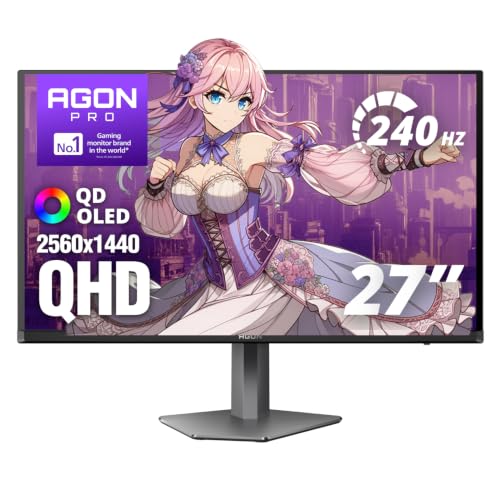
AOC 27-Inch QD-OLED Gaming Monitor
Best for: high-speed competitive 1440p QD-OLED gaming
- Panel Type
- QD-OLED (what this guide is about)
- Screen Size
- 27"
- Resolution
- 2560x1440
- Refresh Rate
- 240Hz
- Response Time
- 0.03ms GTG
- Sync Technology
- G-Sync
The AOC Agon Pro 27-Inch 240Hz QD-OLED Monitor delivers a 2560x1440 resolution paired with a 0.03ms response time and G-Sync support. You get a self-luminous QD-OLED panel covering 101 percent DCI-P3 color space, along with rear customizable lighting and dedicated console modes up to 120Hz. It suits you if you prioritize fast competitive refresh rates and vibrant color reproduction in a standard 27-inch desktop format.
Pros
- 240Hz refresh rate with 0.03ms GTG response time
- Self-luminous QD-OLED panel with 101% DCI-P3 coverage
- G-Sync compatibility for tear-free gaming
- Supports console modes up to 120Hz
Cons
- Standard 16:9 aspect ratio rather than an ultrawide format
- Basic HDR10 support with no advanced dynamic HDR metadata formats listed
Good fit if
- You want 240Hz motion clarity paired with instant 0.03ms response times.
- You need wide color coverage reaching 101% DCI-P3 and 136.7% sRGB.
- You plan to connect a console that outputs at up to 120Hz.
Skip if
- You want an expanded 21:9 ultrawide field of view.
- You require a 4K UHD display resolution.
Verdict: AOC Agon Pro 27-Inch 240Hz QD-OLED Monitor provides rapid 0.03ms response speeds and deep color coverage for fast-paced gameplay. It is an effective 1440p option if you prefer high refresh rates over an ultrawide form factor.

Alienware 34-Inch Curved QD-OLED Monitor
Best for: curved 34-inch ultrawide gaming and color work
- Panel Type
- QD-OLED (what this guide is about)
- Screen Size
- 34-inch
- Refresh Rate
- 165Hz
- Aspect Ratio
- 21:9
- Response Time
- 0.1Ms
- Sync Technology
- AMD FreeSync Premium Pro
The Alienware 34-Inch Curved QD-OLED provides a 21:9 ultrawide panel with a 3440 x 1440 resolution and an 1800R curve. You get a 165Hz refresh rate paired with a 0.1ms response time and AMD FreeSync Premium Pro for gaming. It also covers 99.3% of the DCI-P3 color space with a dedicated Creator Mode. This display fits your desk if you want ultrawide immersion for games and color-critical work.
Pros
- 34-inch 21:9 curved QD-OLED panel with 3440 x 1440 resolution
- 165Hz refresh rate with 0.1ms response time
- 99.3% DCI-P3 color coverage with dedicated sRGB and DCI-P3 Creator Mode
- AMD FreeSync Premium Pro and VESA AdaptiveSync certifications
- Three-year warranty covering panel burn-in
Cons
- 165Hz refresh rate is lower than 240Hz alternatives on the list
- No integrated speakers listed in specifications
- Heavy 20.5-pound weight requires a sturdy mounting arm or desk
Good fit if
- You want a curved 21:9 ultrawide screen for immersive gaming.
- You require factory-tuned sRGB and DCI-P3 modes for color-accurate work.
- You want warranty coverage that explicitly includes burn-in.
Skip if
- You prefer a 240Hz panel for fast-paced competitive esports.
- You want a 4K UHD resolution instead of 1440p ultrawide.
- You need built-in speakers on your monitor.
Verdict: Alienware 34-Inch Curved QD-OLED pairs a 1440p ultrawide form factor with broad color coverage and smooth 165Hz gaming performance. It remains a well-balanced choice for both productivity and gaming.

ArcticPro 27-Inch 240Hz QD-OLED Monitor
Best for: high-speed 1440p QD-OLED gaming setups
- Panel Type
- QD-OLED (what this guide is about)
- Screen Size
- 27 Inch
- Resolution
- 1440p
- Refresh Rate
- 240Hz
- Response Time
- 0.03ms (GtG)
- Dimensions
- 23.6 × 1.6 × 13.4 inches
The ArcticPro 27-Inch 240Hz QHD QD-OLED Monitor provides a 1440p resolution on a 27-inch QD-OLED panel. You get a 240Hz refresh rate with a 0.03ms gray-to-gray response time for fast-paced gameplay. It features 110% DCI-P3 coverage, a 1,500,000:1 contrast ratio, and an ergonomic four-way adjustable stand. Built-in speakers handle basic audio needs. This screen suits you if you want competitive speed in a standard format.
Pros
- 240Hz refresh rate with 0.03ms GtG response time
- 110% DCI-P3 color gamut coverage with Delta E under 2
- 1,500,000:1 static contrast ratio
- Four-direction adjustable ergonomic stand
- Two built-in audio speakers
Cons
- Standard 16:9 aspect ratio instead of an ultrawide format
- 1440p resolution rather than 4K UHD
- Specific video input ports are not listed in the specs
Good fit if
- You want a 240Hz QD-OLED screen with a 0.03ms response time.
- You need an ergonomic stand that tilts, swivels, pivots, and adjusts in height.
- You require wide color coverage rated at 110% DCI-P3.
Skip if
- You want a 21:9 or 32:9 ultrawide panel format.
- You prefer a 4K resolution over 1440p.
Verdict: ArcticPro 27-Inch 240Hz QHD QD-OLED Monitor delivers fast 240Hz performance and high color accuracy on a 1440p panel. It is a solid choice if you want QD-OLED technology without an ultrawide footprint.

ASUS 32-Inch 4K QD-OLED Gaming Monitor
Best for: high-refresh 4K gaming and single-cable laptop setups
- Panel Type
- QD-OLED (what this guide is about)
- Screen Size
- 32-inch
- Resolution
- 3840 x 2160
- Refresh Rate
- 240 Hz
- Response Time
- 0.03 ms GTG
- Sync Technology
- G-SYNC Compatible
This 32-inch display pairs a 4K UHD resolution with a 240 Hz refresh rate on a QD-OLED panel. You get a rapid 0.03 ms response time alongside G-SYNC compatibility and 90W USB-C power delivery for single-cable laptop connections. It suits you if you want high-density 4K clarity and high-speed motion handling for both competitive and cinematic gaming on a standard widescreen desktop display.
Pros
- 3840 x 2160 4K QD-OLED panel with 240 Hz refresh rate
- 0.03 ms GTG response time with G-SYNC compatibility
- USB-C port with 90W power delivery
- 99% DCI-P3 color gamut with VESA DisplayHDR 400 True Black
- Three-year warranty covering burn-in
Cons
- Standard 16:9 aspect ratio rather than an ultrawide format
- DisplayHDR 400 True Black certification limits maximum HDR brightness tiers
- Total weight of 19.4 pounds requires a sturdy desk or mount
Good fit if
- You want 4K UHD pixel density alongside a 240 Hz refresh rate.
- You need 90W USB-C power delivery to charge and connect a laptop.
- You want three years of warranty protection that includes burn-in coverage.
Skip if
- You prefer an ultrawide 21:9 or 32:9 aspect ratio over standard 16:9.
- You do not have PC hardware capable of pushing 4K resolution at high frame rates.
Verdict: ASUS 32-Inch 4K 240Hz QD-OLED Monitor delivers exceptional 4K clarity and fast 240 Hz performance for demanding setups. Its 90W USB-C power delivery and comprehensive burn-in warranty make it a reliable flagship option.

Dell 32-Inch 4K QD-OLED Monitor
Best for: 4K gaming and USB-C laptop workflows
- Panel Type
- QD-OLED (what this guide is about)
- Screen Size
- 31.6"
- Resolution
- 4K
- Refresh Rate
- 120Hz
- Response Time
- 0.03ms
- Sync Technology
- AMD FreeSync Premium Pro
The Dell 32-Inch 4K 120Hz QD-OLED Monitor pairs a 31.6-inch 4K QD-OLED panel with a 120Hz refresh rate. It delivers a 0.03ms response time, AMD FreeSync Premium Pro, and 99% DCI-P3 color coverage. A single USB-C port provides video and 90W power delivery. This display suits you if you want sharp 4K resolution, deep OLED contrast, and laptop docking capability without needing ultra-high 240Hz competitive gaming refresh rates.
Pros
- 4K QD-OLED panel with 99% DCI-P3 color gamut
- Fast 0.03ms response time with AMD FreeSync Premium Pro
- USB-C connectivity with up to 90W power delivery
- Integrated 5x5W speakers with spatial audio
Cons
- 120Hz maximum refresh rate is lower than 240Hz alternatives
- 16:9 aspect ratio does not offer ultrawide horizontal space
- Heavy total weight of 22.1 pounds
Good fit if
- You need a 4K QD-OLED screen with 90W USB-C power delivery for your laptop.
- You prioritize 4K visual clarity and color accuracy over refresh rates above 120Hz.
Skip if
- You want a 240Hz refresh rate for fast-paced competitive esports.
- You prefer a true ultrawide 21:9 or 32:9 desktop workspace.
Verdict: Dell 32-Inch 4K 120Hz QD-OLED Monitor provides crisp 4K imagery, low 0.03ms latency, and convenient 90W USB-C connectivity. It serves as a balanced option for everyday productivity and smooth 120Hz gaming.

Samsung 49-Inch Odyssey QD-OLED Gaming Monitor
Best for: super-ultrawide immersion and dual-window multitasking
- Panel Type
- QD-OLED (what this guide is about)
- Screen Size
- 49"
- Resolution
- 5120 x 1440
- Refresh Rate
- 144Hz
- Aspect Ratio
- 32:9
- Response Time
- 0.03ms
View on Amazon: Samsung 49-Inch Odyssey QD-OLED Gaming Monitor
This 49-inch curved monitor combines a QD-OLED panel with an ultra-wide 32:9 aspect ratio and a 5120 x 1440 Dual QHD resolution. It gives you 110 pixels per inch alongside a 144Hz refresh rate and a 0.03ms response time. With AMD FreeSync Premium Pro and G-Sync compatibility, it delivers smooth motion. It suits you if you want a massive display for flight simulators, racing setups, or wide multitasking.
Pros
- 5120 x 1440 Dual QHD resolution on a 32:9 curved panel
- Fast 0.03ms response time with 144Hz refresh rate
- Thermal modulation, logo detection, and taskbar dimming safeguards
- AMD FreeSync Premium Pro and G-Sync compatibility
Cons
- 144Hz refresh rate is lower than the 240Hz rate on smaller QD-OLED panels
- Large 47-inch footprint and 28.4-pound weight require deep desk space
Good fit if
- You want a single 49-inch 32:9 screen to replace a dual-monitor 1440p setup.
- You play simulation or immersive games that support a 5120 x 1440 aspect ratio.
Skip if
- You prioritize a 240Hz refresh rate over extra screen width.
- You have a compact desk that cannot support a 47-inch wide base.
Verdict: Samsung Odyssey OLED G9 49-Inch Curved Monitor delivers expansive 32:9 visuals with pure blacks and rapid 0.03ms response times. Its 5120 x 1440 resolution provides vast desktop area, though its 144Hz refresh rate trails 240Hz alternatives.

Samsung 49-inch Odyssey QD-OLED Gaming Monitor
Best for: super ultrawide 240Hz curved gaming
- Panel Type
- QD-OLED (what this guide is about)
- Screen Size
- 49"
- Refresh Rate
- 240Hz
- Response Time
- 0.03ms (GTG)
- Sync Technology
- G-Sync Compatible
- Connectivity
- HDMI 2.1, DisplayPort, USB
View on Amazon: Samsung 49-inch Odyssey QD-OLED Gaming Monitor
This 49-inch curved QD-OLED monitor gives you an expansive 1800R ultrawide view equivalent to two quad-definition displays placed side by side. It features a 240Hz refresh rate paired with a 0.03ms gray-to-gray response time and G-Sync compatibility for fast-paced gameplay. DisplayHDR True Black 400 provides high contrast and deep black levels. It suits you if you want a massive single-panel setup driven by modern HDMI 2.1 or DisplayPort connections.
Pros
- Expansive 49-inch 1800R curved QD-OLED panel
- 240Hz refresh rate and 0.03ms (GTG) response time
- DisplayHDR True Black 400 certification
- HDMI 2.1, DisplayPort, and USB hub connectivity
Cons
- Requires 47.1 inches of horizontal desk space
- Heavy 27.8-pound total weight
Good fit if
- You want an expansive 49-inch screen with an 1800R curve.
- You need high-speed 240Hz gaming with 0.03ms response times.
- You connect modern systems using HDMI 2.1 or DisplayPort.
Skip if
- You have limited desk depth or width for a 47.1-inch wide frame.
- You prefer a conventional flat 16:9 aspect ratio display.
Verdict: Samsung 49-Inch Odyssey Curved QD-OLED Monitor delivers a 240Hz refresh rate and 0.03ms response time across a wide 1800R curved display. It provides fluid performance if you have the desk space for its 47.1-inch width.

Alienware 27-Inch 4K 240Hz QD-OLED Monitor
Best for: high-density 4K gaming in standard 16:9
- Panel Type
- QD-OLED (what this guide is about)
- Screen Size
- 27"
- Resolution
- 4K
- Refresh Rate
- 240Hz
- Dimensions
- 8.27 × 24 × 16 inches
- Weight
- 15 pounds
This renewed Alienware display pairs a 27-inch QD-OLED panel with native 4K resolution and a 240Hz refresh rate. It delivers a pixel density of 166 PPI alongside Dolby Vision and VESA DisplayHDR True Black 400 support. If you want high pixel density and fast frame rates for gaming in a compact footprint rather than an ultra-wide format, this monitor gives you sharp visuals and fluid motion.
Pros
- 4K UHD resolution with 166 PPI pixel density
- Fast 240Hz refresh rate on a QD-OLED panel
- Dolby Vision and VESA DisplayHDR True Black 400 certification
- Integrated 360-degree ventilation and internal cable management
Cons
- Standard 16:9 screen size instead of an ultrawide aspect ratio
- Renewed product condition
Good fit if
- You want 4K clarity and a 240Hz refresh rate on a 27-inch QD-OLED panel.
- You need HDR support including Dolby Vision and DisplayHDR True Black 400.
- You prefer a dense 166 PPI image over a wider ultrawide display.
Skip if
- You need an ultrawide 21:9 or 32:9 display format.
- You prefer purchasing a factory-new unit over renewed equipment.
Verdict: Alienware 27-Inch 4K 240Hz QD-OLED Monitor delivers high pixel density and fast refresh rates for setups where standard 16:9 4K clarity fits better than an ultrawide screen.

MSI 27-Inch 240Hz QD-OLED Gaming Monitor
Best for: Competitive 1440p gaming on a standard display
- Panel Type
- QD-OLED (what this guide is about)
- Screen Size
- 27"
- Resolution
- 2560 x 1440
- Refresh Rate
- 240Hz
- Response Time
- 0.03ms (GtG)
- Sync Technology
- Adaptive-Sync
This MSI monitor is a 27-inch QD-OLED display featuring a 2560 x 1440 resolution and a 240Hz refresh rate. It delivers a 0.03ms response time, 99% DCI-P3 color coverage, and Adaptive-Sync support for fast-paced gaming. A fanless graphene heatsink and OLED Care 2.0 manage heat and panel longevity. It suits you if you want high-speed competitive performance on a standard 1440p screen rather than an ultrawide canvas.
Pros
- 240Hz refresh rate paired with 0.03ms GtG response time
- QD-OLED panel with 99% DCI-P3 coverage and Delta E ≤2 accuracy
- Fanless graphene heatsink for silent thermal management
- HDMI 2.1 CEC and DisplayPort 1.4a video inputs
Cons
- Standard 16:9 aspect ratio rather than an ultrawide format
- Peak brightness capped at 400 nits
- 1440p resolution provides less workspace than 4K
Good fit if
- You want a 240Hz refresh rate with a 0.03ms response time for fast gaming.
- You prefer a 2560 x 1440 resolution on a 27-inch display.
- You need accurate color reproduction with 99% DCI-P3 coverage.
Skip if
- You need an ultrawide 21:9 or 32:9 aspect ratio for expansive multitasking.
- You prefer a 4K resolution panel for higher pixel density.
Verdict: MSI 27-Inch 240Hz QD-OLED Gaming Monitor delivers responsive 1440p visuals and broad color accuracy for competitive players who favor a traditional screen format over ultrawide.
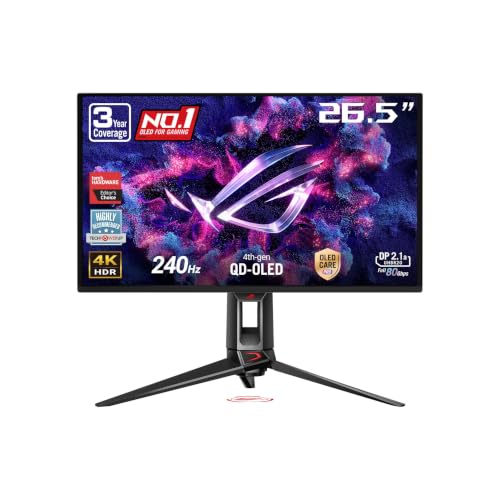
ASUS 27-Inch 4K 240Hz QD-OLED Monitor
Best for: compact 4K 240Hz competitive desk setups
- Panel Type
- QD-OLED (what this guide is about)
- Screen Size
- 26.5-inch
- Resolution
- 3840 x 2160
- Refresh Rate
- 240Hz
- Response Time
- 0.03ms
- Connectivity
- DisplayPort 2.1a, USB-C, HDMI 2.1
The ASUS ROG 27-Inch 4K 240Hz QD-OLED Monitor delivers a 3840 x 2160 resolution on a 26.5-inch QD-OLED panel. It features a 240Hz refresh rate alongside a 0.03ms response time for fast visual output. Connectivity includes DisplayPort 2.1a with 80Gbps bandwidth, HDMI 2.1, and a 90W USB-C port. This display suits you if you want high-density 4K clarity, rapid refresh rates, and versatile single-cable power delivery for your gaming setup.
Pros
- Native 4K resolution with 240Hz refresh rate and 0.03ms response time
- DisplayPort 2.1a UHBR20 with full 80Gbps bandwidth
- USB-C port with 90W Power Delivery
- Three-year warranty covering burn-in
Cons
- Standard 16:9 aspect ratio rather than an ultrawide format
- Smaller 26.5-inch viewable area compared to 32-inch alternatives
Good fit if
- You want 4K visual density paired with a 240Hz refresh rate.
- You require DisplayPort 2.1a bandwidth or 90W USB-C charging.
- You need a fast 0.03ms response time for fast-paced gaming.
Skip if
- You want an ultrawide 21:9 or 32:9 aspect ratio.
- You prefer a larger 32-inch or 49-inch screen size.
Verdict: ASUS ROG 27-Inch 4K 240Hz QD-OLED Monitor pairs high 4K pixel density and 240Hz speed with high-bandwidth DisplayPort 2.1a connectivity. It provides top-tier speed and clarity if you prefer a compact 16:9 screen over an ultrawide layout.

Acer Predator 31.5-Inch Curved 4K QD-OLED
Best for: Curved 4K gaming with high refresh rates
- Panel Type
- QD-OLED (what this guide is about)
- Screen Size
- 31.5"
- Resolution
- 3840x2160
- Refresh Rate
- 240Hz
- Aspect Ratio
- 16:9
- Response Time
- 0.03ms (G to G)
The Acer Predator 31.5-Inch Curved 4K QD-OLED pairs a 3840x2160 UHD panel with a 240Hz refresh rate and a 0.03ms response time. Built with a 1700R curve, it provides 99% DCI-P3 color coverage and VESA DisplayHDR True Black 400. While formatted in a standard 16:9 aspect ratio rather than ultrawide, it suits you if you want high pixel density, fast refresh speeds, and ergonomic tilt, swivel, and height adjustments for gaming.
Pros
- 3840x2160 4K UHD resolution across a 31.5-inch panel
- 240Hz refresh rate with 0.03ms response time
- VESA DisplayHDR True Black 400 and 99% DCI-P3 color gamut
- Ergonomic stand with tilt, swivel, and height adjustments
Cons
- Standard 16:9 aspect ratio instead of a wider format
- Substantial footprint measuring 13.6 inches deep and 21.4 pounds
Good fit if
- You want a curved 4K QD-OLED display running at 240Hz.
- You need an adjustable stand with tilt, swivel, and height clearance.
- You prioritize 99% DCI-P3 color gamut with true 10-bit color support.
Skip if
- You require an ultrawide 21:9 or 32:9 panoramic aspect ratio.
- You have a shallow desktop that cannot accommodate a 13.6-inch depth.
Verdict: Acer Predator 31.5-Inch Curved 4K QD-OLED delivers crisp 4K imagery and fluid 240Hz motion on a 1700R curved display. It offers versatile ergonomic adjustments and true 10-bit color, though its 16:9 aspect ratio limits extra horizontal screen width.

GIGABYTE 27-Inch 4K 240Hz QD-OLED Monitor
Best for: high-density 4K competitive gaming
- Panel Type
- QD-OLED (what this guide is about)
- Screen Size
- 27"
- Resolution
- 4K UHD
- Refresh Rate
- 240Hz
- Response Time
- 0.03ms GtG
- Sync Technology
- AMD FreeSync Premium Pro
The Gigabyte 27" 4K 240Hz QD-OLED Gaming Monitor brings a 4K UHD panel to a standard 27-inch footprint. It provides a 240Hz refresh rate and a 0.03ms GtG response time for fast motion. You get 99% DCI-P3 color coverage and AMD FreeSync Premium Pro. A fanless design uses graphene thermal film for heat dissipation. It suits you if you prioritize high pixel density over an ultrawide screen.
Pros
- 4K UHD resolution with 166 PPI pixel density
- 240Hz refresh rate and 0.03ms GtG response time
- 99% DCI-P3 color gamut with 10-bit color depth
- Fanless cooling using graphene thermal film and heatsink
Cons
- Standard 16:9 aspect ratio rather than an ultrawide layout
- No integrated speakers listed in specifications
Good fit if
- You want 4K resolution and high pixel density on a 27-inch display.
- You need a 240Hz refresh rate and 0.03ms response time for fast-paced gaming.
- You prefer silent, fanless thermal cooling.
Skip if
- You want an ultrawide 21:9 or 32:9 aspect ratio.
- You need built-in monitor speakers.
Verdict: Gigabyte 27" 4K 240Hz QD-OLED Gaming Monitor pairs a dense 166 PPI 4K panel with a fast 240Hz refresh rate. It suits competitive setups where you want high pixel density in a traditional 27-inch form factor.

MSI 27-Inch 360Hz QD-OLED Monitor
Best for: high-refresh competitive gaming and console setups
- Panel Type
- QD-OLED (what this guide is about)
- Screen Size
- 27"
- Resolution
- 2560 x 1440
- Refresh Rate
- 360Hz
- Response Time
- 0.03ms GtG
- Connectivity
- HDMI 2.1, DP Port, USB Type C
This MSI monitor pairs a 27-inch QD-OLED panel with a 2560 x 1440 resolution and a 360Hz refresh rate. It delivers a 0.03ms GtG response time alongside full 48 Gbps HDMI 2.1 connectivity for modern consoles and PCs. With built-in KVM support, DisplayHDR True Black 400, and USB-C video input, this display suits competitive players who prioritize high frame rates and quick hardware switching over larger ultrawide screen formats.
Pros
- 360Hz refresh rate with 0.03ms GtG response time
- HDMI 2.1 inputs with full 48 Gbps bandwidth
- Built-in KVM switch and USB Type-C port
- VESA DisplayHDR True Black 400 certification
Cons
- Standard 27-inch 16:9 screen rather than an ultrawide format
- 1440p resolution provides lower pixel density than 4K models
- Heavy build at 24 pounds
Good fit if
- You want a 360Hz refresh rate with 0.03ms GtG response time for fast-paced games.
- You need full 48 Gbps HDMI 2.1 bandwidth for modern gaming consoles.
- You switch peripherals between two systems using an integrated KVM switch.
Skip if
- You want an ultrawide aspect ratio or curved screen.
- You require 4K resolution for desktop workspace or gaming detail.
Verdict: MSI 27-Inch 360Hz QD-OLED Gaming Monitor delivers ultra-fast 360Hz motion handling, low response times, and full-speed HDMI 2.1 bandwidth in a standard 1440p format.
Specifications side by side
| Spec | Alienware 27-Inch 4K QD-OLED Gaming Monitor | Samsung Odyssey 27-Inch 360Hz QD-OLED Monitor | AOC 27-Inch QD-OLED Gaming Monitor | Alienware 34-Inch Curved QD-OLED Monitor | ArcticPro 27-Inch 240Hz QD-OLED Monitor | ASUS 32-Inch 4K QD-OLED Gaming Monitor | Dell 32-Inch 4K QD-OLED Monitor | Samsung 49-Inch Odyssey QD-OLED Gaming Monitor | Samsung 49-inch Odyssey QD-OLED Gaming Monitor | Alienware 27-Inch 4K 240Hz QD-OLED Monitor | MSI 27-Inch 240Hz QD-OLED Gaming Monitor | ASUS 27-Inch 4K 240Hz QD-OLED Monitor | Acer Predator 31.5-Inch Curved 4K QD-OLED | GIGABYTE 27-Inch 4K 240Hz QD-OLED Monitor | MSI 27-Inch 360Hz QD-OLED Monitor |
|---|---|---|---|---|---|---|---|---|---|---|---|---|---|---|---|
| Screen Size | 27" | 27" | 27" | 34-inch | 27 Inch | 32-inch | 31.6" | 49" | 49" | 27" | 27" | 26.5-inch | 31.5" | 27" | 27" |
| Resolution | 3840 x 2160 | QHD | 2560x1440 | not specified | 1440p | 3840 x 2160 | 4K | 5120 x 1440 | not specified | 4K | 2560 x 1440 | 3840 x 2160 | 3840x2160 | 4K UHD | 2560 x 1440 |
| Refresh Rate | 240Hz | 360Hz | 240Hz | 165Hz | 240Hz | 240 Hz | 120Hz | 144Hz | 240Hz | 240Hz | 240Hz | 240Hz | 240Hz | 240Hz | 360Hz |
| Panel Type | QD-OLED | QD-OLED | QD-OLED | QD-OLED | QD-OLED | QD-OLED | QD-OLED | QD-OLED | QD-OLED | QD-OLED | QD-OLED | QD-OLED | QD-OLED | QD-OLED | QD-OLED |
| Aspect Ratio | not specified | not specified | not specified | 21:9 | not specified | not specified | not specified | 32:9 | not specified | not specified | not specified | not specified | 16:9 | not specified | not specified |
| Response Time | 0.03ms GTG | 0.03ms (GtG) | 0.03ms GTG | 0.1Ms | 0.03ms (GtG) | 0.03 ms GTG | 0.03ms | 0.03ms | 0.03ms (GTG) | not specified | 0.03ms (GtG) | 0.03ms | 0.03ms (G to G) | 0.03ms GtG | 0.03ms GtG |
| Sync Technology | G-SYNC Compatible, FreeSync Premium Pro | AMD FreeSync Premium Pro | G-Sync | AMD FreeSync Premium Pro | not specified | G-SYNC Compatible | AMD FreeSync Premium Pro | G-Sync Compatible, AMD FreeSync Premium | G-Sync Compatible | not specified | Adaptive-Sync | not specified | not specified | AMD FreeSync Premium Pro | not specified |
| Connectivity | DisplayPort 1.4, HDMI, USB-C | HDMI 2.1, DisplayPort | not specified | not specified | not specified | USB-C | USB-C | not specified | HDMI 2.1, DisplayPort, USB | not specified | DisplayPort 1.4a, HDMI 2.1 CEC | DisplayPort 2.1a, USB-C, HDMI 2.1 | not specified | not specified | HDMI 2.1, DP Port, USB Type C |
| Size | not specified | 27 Inch | 27" 240Hz AGON PRO | 34.0" OLED | 27" QHD 240Hz QD-OLED | 9.40 | S3225QC | 144Hz Refresh Rate | 240Hz Refresh Rate | not specified | 14" x 24" x 2.6" | not specified | 31.5-inch | 27" | not specified |
| Dimensions | 24 × 8.27 × 16 inches | 10.4 × 24.1 × 21.8 inches | 9.01 × 24 × 20.7 inches | 32.1 × 12 × 20.7 inches | 23.6 × 1.6 × 13.4 inches | 21 × 38 × 49 inches | 8.81 × 28.3 × 19.8 inches | 11.2 × 47 × 20.8 inches | 11.2 × 47.1 × 20.9 inches | 8.27 × 24 × 16 inches | 23.9 × 9.5 × 16.8 inches | 8.6 × 24 × 21.6 inches | 13.6 × 28.1 × 21.5 inches | 7.38 × 24 × 19.7 inches | 24 × 9.5 × 16.6 inches |
| Weight | 9.48 pounds | 15.2 pounds | 14.7 pounds | 20.5 pounds | 6.45 pounds | 19.4 pounds | 22.1 pounds | 28.4 pounds | 27.8 pounds | 15 pounds | 20.7 pounds | 16.8 pounds | 21.4 pounds | 15.7 pounds | 24 pounds |
| Color | Black | Silver | Black | Black | white | BLACK | Ash White | Aluminum Silver | Aluminum Silver | Black | Black | BLACK | Black | Black | Black |
| Model | AW2725Q | LS27DG602SNXZA | AG276QZD2 | AW3423DWF | AD27GOQ4 | PG32UCDM | S3225QC | LS49DG910SNXZA | LS49CG932SNXZA | AW2725Q | MAG 274QP QD-OLED X24 | PG27UCDM | UM.JXXAA.X01 | MO27U2 | MPG 271QRX QD-OLED |
Is A QD-OLED Monitor Worth It?
A QD-OLED panel changes your motion clarity and color reproduction. Models with this panel type specify response times as low as 0.03ms alongside refresh rates between 120Hz and 360Hz. The technology provides pure blacks, high color accuracy, and true 10-bit color for detailed visual output. These panels come in flat 16:9, 1700R curved, and 1800R curved ultrawide layouts. You benefit from low latency during fast action, whether you choose a 1440p resolution, an ultrawide 3440 x 1440 display, or a high-density 4K screen.
Worth it if
- You prioritize 0.03ms response times and high refresh rates from 120Hz to 360Hz for competitive gaming.
- You need pure blacks and true 10-bit color or broad color accuracy for visual work.
Skip it if
- You do not need 0.03ms response times or high refresh rates up to 360Hz.
- You do not require pure blacks, broad color coverage, or true 10-bit color accuracy for your workload.
If you need a compact screen for travel, you can compare display specs across the best OLED portable monitors.
How We Selected These Monitors
We identified models for this guide by checking Amazon listings that state a QD-OLED panel in the title or feature list. To keep your choices clear, you see only one size or variant from each product family. Every detail comes directly from published specifications and manufacturer feature lists. Products are not physically handled.
To help you find the right display, we arrange the 15 picks with products in stock first, then by Amazon sales rank (better-selling products first). We also compare published specs such as resolution, screen size, and refresh rate. Stock information on the page updates at least daily.
Key Specs To Evaluate Before Buying
-
Check Target Refresh Rates
Your choice of refresh rate should match your graphics hardware and target games. Listed models vary between 120Hz, 144Hz, 165Hz, 240Hz, and 360Hz. If you play fast-paced esports titles, prioritize panels reaching higher figures, such as the 360Hz Samsung Odyssey 27-Inch 360Hz QD-OLED Monitor. For casual gaming or graphic production, a 120Hz or 144Hz display provides adequate smoothness without requiring extreme frame rates from your system. Check your GPU capabilities to ensure it can feed your selected refresh rate.
-
Verify USB-C Power Delivery
If you plan to connect a compatible laptop using a single cable, inspect the USB-C specifications closely. Some displays omit USB power, while options like the ASUS 32-Inch 4K QD-OLED Gaming Monitor provide 90W USB-C power delivery alongside display signal transfer. This wattage keeps a notebook charged during demanding sessions without an external power brick. If your setup relies exclusively on a standard desktop computer with DisplayPort cables, USB-C power capacity is less critical for your daily use.
-
Check Variable Sync Standards
Variable refresh rate technology prevents screen tearing by matching display refresh cycles to your graphics card output. Monitor specifications specify either AMD FreeSync, NVIDIA G-SYNC, or both. For example, the Alienware 34-Inch Curved QD-OLED Monitor lists FreeSync support to eliminate tearing during frame rate fluctuations. Confirm which sync protocol your graphics card uses before purchasing. Matching your GPU to the listed sync technology ensures stable tear-free visual performance across fluctuating frame rates in demanding video games.
-
Measure Desk Space Requirements
Physical dimensions and total weight dictate whether a display fits your workspace or existing monitor arm. Large ultrawide units require substantial clearance. For instance, the Samsung 49-Inch Odyssey QD-OLED Gaming Monitor measures 47 inches wide, 11.2 inches deep with its stand, and weighs 28.4 pounds. Compare these exact measurements against your desk width and depth before choosing. Heavier monitors also require heavy-duty mounting hardware if you plan to install them onto an aftermarket desk arm.
-
Review Display Interface Standards
Display inputs determine how much signal bandwidth flows from your graphics card to the screen. High-bandwidth standards like DisplayPort 2.1a on the ASUS 27-Inch 4K 240Hz QD-OLED Monitor handle uncompressed high-resolution signals at 240Hz. Other models supply standard DisplayPort or HDMI ports. If you run current-generation graphics cards or modern game consoles, verify the specific port revisions listed in the product specifications. Proper port matching prevents visual bandwidth bottlenecks and enables maximum native refresh capabilities.
-
Consider Display Screen Curvature
Curved panels wrap the screen edges closer to your natural field of view to reduce peripheral eye movement. Spec sheets express this curvature with an R rating, such as the 1700R radius on the Acer Predator 31.5-Inch Curved 4K QD-OLED. A lower number indicates a tighter curve, which benefits immersive gaming. However, if your daily work involves straight CAD lines or architectural design, a flat screen or subtle curve provides truer geometry without visual distortion.
Frequently asked questions
Which QD-OLED ultrawide monitor offers the widest screen on this list?
The Samsung 49-Inch Odyssey models deliver the widest display on this list at 49 inches diagonally. With a super-ultrawide 32:9 aspect ratio and a 5120 x 1440 resolution, these screens provide extensive desktop space for multitasking or immersive gaming. The 1800R curve keeps the outer edges within your natural field of view, while the 47-inch physical width requires dedicated desk space.
What refresh rates do QD-OLED ultrawide monitors support?
Ultrawide QD-OLED monitors in this guide offer refresh rates ranging from 144Hz up to 240Hz. For instance, the 34-inch Alienware AW3423DWF runs at 165Hz, while the 49-inch Samsung Odyssey options operate at 144Hz or 240Hz. You should verify your graphics card capabilities to ensure your system can push steady frame rates at these high speeds across wide resolutions.
Can you connect a laptop using a single cable on these QD-OLED monitors?
Yes, several QD-OLED monitors feature USB-C connectivity with power delivery for single-cable laptop setups. The ASUS 32-Inch PG32UCDM and Dell 32-Inch S3225QC provide 90W power delivery over USB-C alongside video input. This connection allows you to charge your compatible laptop, output high-resolution display signals, and streamline desktop cabling without relying on dedicated charging bricks or separate display adapters.
Which variable refresh rate technologies do these QD-OLED monitors feature?
The QD-OLED models in this guide include either AMD FreeSync or NVIDIA G-SYNC synchronization technologies. For example, the Alienware 34-Inch AW3423DWF and Samsung Odyssey LS27DG602SNXZA feature FreeSync support, whereas the ASUS PG32UCDM specifies G-SYNC compatibility. These adaptive sync standards dynamically synchronize the monitor refresh rate to your graphics card frame output, helping eliminate screen tearing and stuttering during fast gameplay.
What curvature ratings are available on curved QD-OLED monitors?
Curved models listed here specify curvature ratings such as 1800R and 1700R. The 49-inch Samsung Odyssey features an 1800R curve, while the Acer Predator 31.5-Inch uses a tighter 1700R arc. These curves bring the outer display edges closer to your peripheral vision, improving viewing comfort across wide viewing surfaces without distorting color accuracy or panel geometry from standard seating distances.
What is the highest refresh rate available among QD-OLED monitors in this guide?
The highest refresh rate available in this selection is 360Hz, found on 1440p displays like the Samsung Odyssey G6 and the MSI MPG 271QRX. This high frame rate provides exceptionally smooth motion handling for competitive games. If you prefer higher resolution over extreme speed, other options step down to 240Hz at 4K or 165Hz on curved ultrawide panels.
Which display connections are provided on these QD-OLED gaming displays?
These monitors utilize standard modern video inputs including DisplayPort, HDMI, and USB-C ports. For instance, the MSI MPG 271QRX includes DisplayPort, HDMI, and USB-C inputs, while the ASUS ROG PG27UCDM lists DisplayPort 2.1a connectivity. You should verify that your computer outputs support the required bandwidth to run the monitor native resolution and refresh rate without compression or interface limits.