ASUS vs AOC: Ultrawide Monitors Compared by Specs
As an Amazon Associate we earn from qualifying purchases. Links on this page are affiliate links.
This ASUS vs AOC ultrawide monitor comparison focuses on two 27-inch QHD gaming displays. Both models deliver 1440p resolution and fast refresh rates for smooth gameplay. The primary difference lies in their panel technology and peak brightness capabilities. You must decide between the OLED panel's infinite contrast and the Mini-LED's high peak luminance. Each brand offers distinct advantages for different gaming preferences.
Key differences
| Aspect | ASUS 27-Inch 240Hz Glossy OLED Gaming Monitor | AOC 27-Inch Mini-LED 1440p Gaming Monitor |
|---|---|---|
| Panel Type | WOLED | VA with Mini-LED |
| Refresh Rate | 240Hz | 180Hz |
| Response Time | 0.03ms | 1ms GtG |
| HDR Standard | DisplayHDR 400 True Black | DisplayHDR 1000 |
| Color Gamut | 99% DCI-P3 | 134% sRGB |
| Burn-in Protection | Neo Proximity Sensor | not listed |
Which one should you choose?
Choose ASUS 27-Inch 240Hz Glossy OLED Gaming Monitor if
- You prioritize the fastest possible refresh rate and response time for competitive gaming.
- You want true black levels and infinite contrast through OLED technology.
- You value built-in burn-in protection features like the proximity sensor.
Choose AOC 27-Inch Mini-LED 1440p Gaming Monitor if
- You need higher peak brightness for HDR content via DisplayHDR 1000 certification.
- You prefer a VA panel with Mini-LED backlighting for deeper blacks than standard IPS.
- You want a frameless design with 336 individual dimming zones for local dimming control.
Verdict: Choose the ASUS if you need the highest refresh rate and fastest response time. The AOC is better if you prefer higher peak brightness and a VA panel with Mini-LED backlighting. Your choice depends on whether you value speed or HDR peak luminance more.
Specs: OLED vs Mini-LED
Panel technology
The ASUS XG27AQDMGR uses a WOLED panel, delivering true blacks and high contrast typical of OLED technology. It features a glossy finish, which enhances color vibrancy but may reflect ambient light in bright rooms. The AOC Q27G3XMN employs a VA panel with Mini-LED backlighting and 336 dimming zones. This setup aims for deep blacks and brighter whites, though VA panels can have slower pixel response characteristics compared to OLED. Your choice depends on whether you prefer the instant pixel response of OLED or the high peak brightness potential of Mini-LED backlighting.
Refresh rate
Refresh rate dictates how many times per second the image updates. The ASUS monitor offers a 240Hz refresh rate, providing smoother motion clarity for fast-paced gaming. The AOC model runs at 180Hz, overclocked via DisplayPort 1.4. While both rates are well above the standard 60Hz baseline, the ASUS has a higher maximum frame rate capability. For competitive gamers targeting high frame rates, the extra 60Hz on the ASUS provides a tangible advantage in fluidity. The AOC’s 180Hz is still very fast, but the ASUS leads in this specific metric.
Response time
Response time measures how quickly a pixel changes color, affecting motion blur. The ASUS specifies a 0.03ms gray-to-gray response time, which is exceptionally fast and minimizes ghosting effectively. The AOC lists a 1ms GtG response time. While 1ms is considered rapid for gaming, the 0.03ms figure on the ASUS is technically superior. This difference is most noticeable in extremely fast-moving scenes. The ASUS OLED technology naturally excels here, offering clearer motion clarity than the Mini-LED VA panel of the AOC.
HDR performance
HDR compliance affects how well bright highlights are rendered. The AOC monitor is VESA DisplayHDR 1000 certified, allowing for higher peak brightness levels compared to the ASUS. The ASUS is VESA DisplayHDR 400 True Black compliant. While the ASUS OLED panel has perfect contrast ratios, the AOC’s Mini-LED backlighting can achieve higher absolute brightness values, which is beneficial for HDR content with bright sun or light sources. If you prioritize peak luminance in HDR scenes, the AOC has the edge.
Color accuracy
Color gamut and accuracy are crucial for creative work and immersive visuals. The ASUS covers 99% of the DCI-P3 gamut with true 10-bit color and a Delta E of less than 2, ensuring high fidelity. The AOC covers 134% of the sRGB gamut. While the AOC offers a wide sRGB range, the ASUS specification for DCI-P3 and 10-bit color suggests better performance for professional color grading and cinematic content. The ASUS provides more precise color reproduction out of the box for users who value accuracy over sheer gamut width.
Which monitor fits your needs
Competitive FPS players wanting speed
The ASUS XG27AQDMGR offers a 240Hz refresh rate and a 0.03ms response time. This combination ensures smoother motion clarity and eliminates ghosting during fast-paced gaming sessions. The high refresh rate allows you to track moving opponents with greater precision than lower refresh rate displays.
Users prioritizing peak HDR brightness
The AOC Q27G3XMN features VESA DisplayHDR 1000 compliance. It uses Mini-LED backlight technology with 336 individual dimming zones. This setup produces true blacks and brighter whites, delivering stunning imagery with rich details. The higher peak brightness makes it suitable for bright room environments.
Creators needing accurate color reproduction
The ASUS monitor provides 99% DCI-P3 gamut coverage and true 10-bit color. It achieves a Delta E of less than 2 for color accuracy. This specification ensures astonishing HDR performance and true-to-life images. The included ASUS DisplayWidget Center software allows easy access to these settings.
The products compared

ASUS 27-Inch 240Hz Glossy OLED Gaming Monitor
Best for: competitive gamers seeking speed and color accuracy
- Screen Size
- 26.5 inch
- Resolution
- 2560 x 1440
- Refresh Rate
- 240Hz
- Panel Type
- WOLED
- Response Time
- 0.03ms GTG
- Sync Technology
- ELMB Sync
View on Amazon: ASUS 27-Inch 240Hz Glossy OLED Gaming Monitor Affiliate link
This 27-inch ASUS ROG monitor uses a WOLED panel with 2560 x 1440 resolution. It offers a 240Hz refresh rate and 0.03ms response time for fast motion. The display covers 99% DCI-P3 color with VESA DisplayHDR 400 True Black certification. It includes ASUS OLED Care Pro to reduce burn-in risk. This setup suits gamers who prioritize speed and color accuracy over screen size.
Pros
- 240Hz refresh rate on a 27-inch QHD WOLED panel
- 0.03ms gray-to-gray response time for smooth motion
- 99% DCI-P3 color gamut with Delta E < 2 accuracy
- ASUS OLED Care Pro with Neo Proximity Sensor to prevent burn-in
Cons
- 27-inch screen size is smaller than the 27-inch Mini-LED alternative
- VESA DisplayHDR 400 True Black rating is lower than HDR1000 standards
- Requires desktop software (DisplayWidget Center) for settings adjustment
Good fit if
- You want the fastest response time available for competitive gaming
- You prioritize color accuracy and deep blacks in a compact size
- You want built-in burn-in protection technology
Skip if
- You need HDR1000 brightness levels for vivid highlights
- You prefer a larger screen real estate for productivity
- You want a glossy-free matte display surface
Verdict: ASUS 27-inch 240Hz OLED Gaming Monitor delivers elite speed and color fidelity for competitive players who value a compact 27-inch footprint and advanced burn-in safeguards.
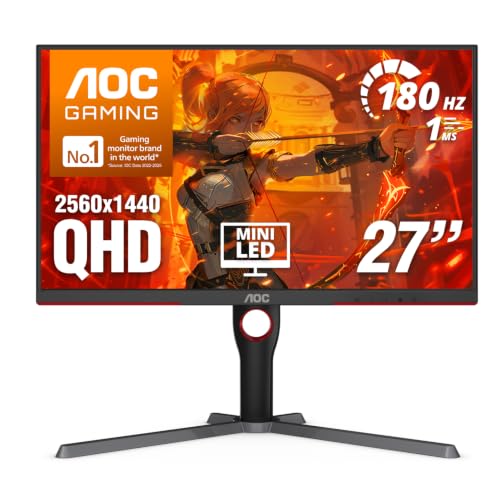
AOC 27-Inch Mini-LED 1440p Gaming Monitor
Best for: HDR gaming with high contrast needs
- Screen Size
- 27 Inch
- Resolution
- 2560x1440
- Refresh Rate
- 180Hz
- Response Time
- 1ms GtG
- Sync Technology
- Adaptive-Sync
- Connectivity
- DP 1.4, HDMI 2.1, USB 3.2
View on Amazon: AOC 27-Inch Mini-LED 1440p Gaming Monitor Affiliate link
The AOC Q27G3XMN is a 27-inch gaming monitor with a 1440p VA panel and Mini-LED backlighting. It features 336 dimming zones for high contrast and VESA DisplayHDR 1000 certification. The display offers a 180Hz refresh rate and 1ms response time for smooth motion. This model suits players who want bright HDR highlights and deep blacks without the cost of OLED.
Pros
- 336 Mini-LED dimming zones for enhanced contrast
- VESA DisplayHDR 1000 rating for bright highlights
- 180Hz refresh rate via DisplayPort 1.4
- 134% sRGB color gamut coverage
Cons
- VA panel may show slower response in dark transitions
- No mention of USB-C connectivity in specifications
- Limited viewing angles compared to IPS panels
Good fit if
- You prioritize high contrast and HDR brightness
- You play fast-paced games at 1440p
- You want a 27-inch frameless design
Skip if
- You need USB-C connectivity for single-cable setups
- You require wide viewing angles for shared screens
- You prefer OLED for perfect black levels
Verdict: AOC 27-inch 180Hz Mini-LED Monitor delivers strong HDR performance and sharp 1440p visuals for competitive gaming. It fits players who value contrast and brightness over the absolute fastest pixel response times.
Specifications side by side
| Spec | ASUS 27-Inch 240Hz Glossy OLED Gaming Monitor | AOC 27-Inch Mini-LED 1440p Gaming Monitor |
|---|---|---|
| Screen Size | 26.5 inch | 27 Inch |
| Resolution | 2560 x 1440 | 2560x1440 |
| Refresh Rate | 240Hz | 180Hz |
| Panel Type | WOLED | not stated |
| Response Time | 0.03ms GTG | 1ms GtG |
| Sync Technology | ELMB Sync | Adaptive-Sync |
| Connectivity | not stated | DP 1.4, HDMI 2.1, USB 3.2 |
| Dimensions | 7.4 × 23.8 × 19.7 inches | 10.2 × 23.8 × 20.9 inches |
| Weight | 14.6 pounds | 15.6 pounds |
| Size | 14.5" x 23.8" x 2.5" | 27" 180Hz Mini-LED |
| Color | BLACK | Black |
| Model | XG27AQDMGR | Q27G3XMN |
Frequently asked questions
Which monitor offers the fastest refresh rate for competitive gaming?
The ASUS model provides a 240Hz refresh rate, which is faster than the AOC unit. This higher rate ensures smoother motion clarity during intense gameplay. The AOC monitor operates at 180Hz, which is still very fast but slightly lower than the ASUS specification.
What is the difference between the panel technologies used by these brands?
The ASUS display uses a WOLED panel type, known for true blacks and high contrast. The AOC monitor utilizes Mini-LED technology, which offers strong HDR performance and high brightness. Your choice depends on whether you prioritize the contrast of OLED or the peak brightness of Mini-LED.
Do these ultrawide monitors share the same screen resolution?
Yes, both monitors deliver a 1440p resolution. This QHD clarity provides sharp visuals for gaming and productivity. Both the ASUS and AOC models maintain this standard resolution despite their different panel technologies and refresh rates.
How much space does each monitor take up on a desk?
The ASUS monitor measures 23.8 inches in width and weighs 14.6 pounds. The AOC unit is also 23.8 inches wide but weighs 15.6 pounds. Both fit a similar 27-inch footprint, though the AOC model is slightly heavier and deeper at 10.2 inches compared to the ASUS depth.
Which model is better for gaming with high contrast needs?
The AOC monitor is best for HDR gaming with high contrast needs. Its Mini-LED panel delivers strong contrast and brightness performance. While the ASUS OLED also offers high contrast, the AOC is specifically noted for players who value contrast and brightness over the absolute fastest pixel response times.
What are the physical dimensions of the ASUS 27-inch OLED monitor?
The ASUS XG27AQDMGR measures 23.8 inches in width, 19.7 inches in height, and 7.4 inches in depth. It weighs 14.6 pounds and comes in a black color. These dimensions provide a compact footprint suitable for various desk setups.