ASUS ZenScreen 16-Inch Portable Monitor vs ASUS ProArt 24-Inch 16:10 Monitor: Spec Comparison
As an Amazon Associate we earn from qualifying purchases. Links on this page are affiliate links.
You are comparing the asus zenscreen 15 6 1080p portable vs proart pa248qv 24 inch. Both monitors use IPS panels for wide viewing angles. The ZenScreen is a 15.6-inch portable display designed for travel. The ProArt is a 24-inch desktop monitor built for stationary work. You need to decide between mobility and professional screen real estate.
Key differences
| Aspect | ASUS ZenScreen 16-Inch Portable Monitor | ASUS ProArt 24-Inch 16:10 Monitor |
|---|---|---|
| Screen Size | 15.6 inches | 24 inches |
| Resolution | 1920 x 1080 | 1920 x 1200 |
| Aspect Ratio | 16:9 | 16:10 |
| Connectivity | USB Type-C | DisplayPort, HDMI, D-Sub |
| Weight | 3.2 pounds | 13.5 pounds |
Which one should you choose?
Choose ASUS ZenScreen 16-Inch Portable Monitor if
- You need a lightweight screen for travel or mobile offices.
- You want a single USB-C cable for power and video.
- You require a compact display that fits in a bag.
Choose ASUS ProArt 24-Inch 16:10 Monitor if
- You need extra vertical space for spreadsheets or code.
- You want a large desktop monitor for stationary use.
- You require multiple legacy ports like D-Sub and HDMI.
Verdict: Choose the ZenScreen if portability and simple USB-C connectivity are your priorities. Pick the ProArt if you need a larger 16:10 canvas for detailed professional work. The choice depends entirely on whether you move your monitor or keep it on a desk.
ZenScreen vs ProArt Spec Showdown
Screen Size and Portability
The ASUS ZenScreen 16-Inch Portable Monitor features a 15.6-inch display with a slim profile measuring just 0.31 inches thick and weighing 3.2 pounds. It is designed for on-the-go use, fitting easily into bags for client meetings. In contrast, the ASUS ProArt 24-Inch 16:10 Monitor has a much larger 24-inch screen. It is a stationary desktop unit weighing 13.5 pounds with a depth of 7.56 inches. The ZenScreen wins for travel, while the ProArt offers a substantial workspace for fixed setups.
Resolution and Aspect Ratio
Resolution impacts clarity and available screen real estate. The ZenScreen provides a Full HD resolution of 1920 x 1080 pixels in a standard 16:9 aspect ratio. The ProArt delivers a WUXGA resolution of 1920 x 1200 pixels with a 16:10 aspect ratio. The extra 120 vertical pixels in the ProArt provide more vertical space, which is beneficial for document editing and coding. Both share the same horizontal pixel count, but the ProArt’s taller screen offers a practical advantage for productivity tasks.
Connectivity Options
Connectivity determines how easily you can link your devices. The ZenScreen relies on a hybrid-signal solution via USB Type-C or Type A ports, which handles both power and video transmission. This makes it highly compatible with various laptops without needing extra power bricks. The ProArt offers DisplayPort, HDMI, and D-Sub ports. It lacks USB-C video input in this specific model. The ZenScreen is more versatile for modern laptops, while the ProArt suits devices with traditional video outputs.
Ergonomics and Stand
Ergonomics affect long-term comfort during use. The ProArt includes a versatile stand that supports tilt, pivot, swivel, and height adjustments. This allows you to position the screen precisely for your posture and desk layout. The ZenScreen uses a foldable lite smart case that doubles as a stand. It props the monitor up in portrait or landscape modes but lacks the fine-tuned adjustability of a full stand. The ProArt is superior for customizable viewing angles and heights.
Color Accuracy and Certification
Color fidelity is critical for creative work. The ProArt covers 100% of the sRGB and Rec.709 color spaces. It is Calman verified with DeltaE < 2, ensuring precise and accurate color reproduction for professional tasks. The ZenScreen focuses on eye comfort with TÜV Rheinland-certified Flicker-free and Low Blue Light technologies. It does not list specific color space coverage or calibration data. For color-critical work, the ProArt is the clear choice due to its verified accuracy.
Which monitor fits your workflow
Travelers needing a lightweight secondary screen
The ZenScreen weighs only 3.2 pounds and measures 0.31 inches thick. Its USB Type-C connection allows power and video transmission from a single cable. The foldable case doubles as a stand. Auto-rotation adjusts the 1920 x 1080 IPS display between landscape and portrait modes. This portability makes it ideal for client meetings on the go.
Designers requiring precise color accuracy
The ProArt PA248QV covers 100% sRGB and Rec.709 color spaces with DeltaE less than 2. It is Calman verified for consistent hue reproduction. The 1920 x 1200 WUXGA resolution on a 24-inch IPS panel provides sharper vertical space. This professional-grade color fidelity ensures true-to-life images for creative work without the need for external calibration tools.
Users wanting ergonomic desk adjustments
The ProArt features a versatile stand with tilt, pivot, swivel, and height adjustment. These ergonomic options allow you to customize the viewing angle for prolonged comfort. In contrast, the ZenScreen relies on a foldable case for positioning. The ProArt’s stationary design prioritizes stability and adjustability for a dedicated workspace setup.
The products compared

ASUS ZenScreen 16-Inch Portable Monitor
Best for: portable secondary displays and travel
- Screen Size
- 15.6”
- Resolution
- 1920 x 1080
- Panel Type
- IPS
- Connectivity
- USB Type-C
- Dimensions
- 14.2 × 8.91 × 0.31 inches
- Weight
- 3.2 pounds
View on Amazon: ASUS ZenScreen 16-Inch Portable Monitor Affiliate link
This is a 15.6-inch portable monitor featuring a 1920 x 1080 resolution and an IPS panel. It connects via USB Type-C to support video and power transmission. The device includes an anti-glare screen and TÜV Rheinland-certified Eye Care technology. Weighing 3.2 pounds, it fits easily in your bag for travel or client meetings.
Pros
- 15.6-inch Full HD (1920x1080) IPS display
- USB Type-C connectivity for power and video
- Auto-rotation between landscape and portrait modes
- Foldable smart case doubles as a stand
- TÜV Rheinland-certified Flicker-free and Low Blue Light
Cons
- 1080p resolution is lower than the 16:10 WUXGA panel on the comparison list
- 15.6-inch screen is smaller than the 24-inch display on the comparison list
- No mention of built-in speakers or headphone jack
Good fit if
- You need a lightweight secondary screen for travel
- You want to use portrait orientation for documents
- You prefer an anti-glare IPS panel
Skip if
- You require a 24-inch or larger display
- You need high-resolution WUXGA or 4K clarity
- You want a stationary desktop monitor
Verdict: ASUS ZenScreen 15.6 Portable Monitor is a compact, lightweight solution for users who prioritize portability and USB-C convenience over screen size and high resolution.
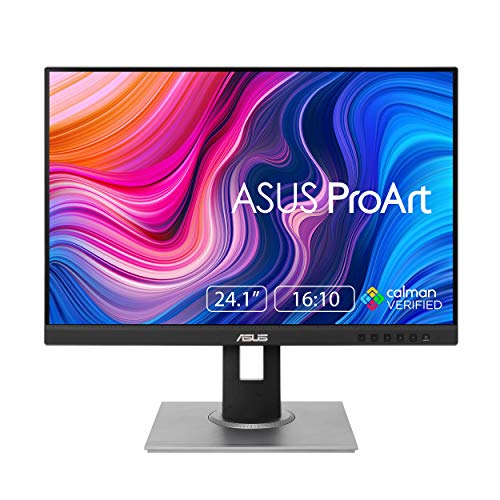
ASUS ProArt 24-Inch 16:10 Monitor
Best for: color-accurate desktop productivity and photo editing
- Screen Size
- 24 Inch
- Resolution
- 1920 x 1200
- Panel Type
- IPS
- Aspect Ratio
- 16:10
- Connectivity
- DisplayPort, HDMI, D-Sub
- Dimensions
- 22.6 × 18.7 × 7.56 inches
View on Amazon: ASUS ProArt 24-Inch 16:10 Monitor Affiliate link
This 24-inch IPS desktop monitor features a 16:10 aspect ratio with a 1920 x 1200 WUXGA resolution. It provides 100% sRGB and Rec.709 color coverage with factory-calibrated Delta E under 2 accuracy. An ergonomic stand allows height, tilt, swivel, and pivot adjustments. It suits you if you need reliable color precision and vertical screen space for desktop work.
Pros
- 100% sRGB and Rec.709 coverage with Delta E < 2 calibration
- 16:10 aspect ratio offers 1920 x 1200 WUXGA resolution
- Ergonomic stand supports tilt, pivot, swivel, and height adjustments
- Up to 5 years of warranty coverage with registration
Cons
- Weighs 13.5 pounds, requiring a permanent desk setup
- Lacks a USB-C video input port
- Resolution tops out at 1920 x 1200
Good fit if
- You need verified color accuracy with Delta E < 2 for visual editing.
- You want extra vertical viewing area from a 16:10 desktop screen.
- You require a fully adjustable stand for height, pivot, and swivel positioning.
Skip if
- You need a lightweight screen for mobile travel use.
- You want single-cable USB-C video input for your laptop.
- You require 1440p or 4K resolution.
Verdict: ASUS ProArt 24-Inch 16:10 Monitor gives color-conscious creators accurate sRGB reproduction on a versatile desktop stand. It suits users who prioritize vertical working space and reliable calibration over travel portability.
Specifications side by side
| Spec | ASUS ZenScreen 16-Inch Portable Monitor | ASUS ProArt 24-Inch 16:10 Monitor |
|---|---|---|
| Screen Size | 15.6” | 24 Inch |
| Resolution | 1920 x 1080 | 1920 x 1200 |
| Panel Type | IPS | IPS |
| Aspect Ratio | not stated | 16:10 |
| Connectivity | USB Type-C | DisplayPort, HDMI, D-Sub |
| Size | 16 Inch | 24 Inch |
| Dimensions | 14.2 × 8.91 × 0.31 inches | 22.6 × 18.7 × 7.56 inches |
| Weight | 3.2 pounds | 13.5 pounds |
| Color | Dark Gray | BLACK |
| Model | MB16ACE | PA248QV |
Frequently asked questions
Is the ASUS ZenScreen 16-Inch Portable Monitor good for travel?
Yes, it is designed for portability. It weighs only 3.2 pounds and measures just 0.31 inches thick. Its compact size allows it to fit easily into bags for client meetings or remote work setups. You get a lightweight solution that prioritizes mobility over large screen real estate.
What resolution does the ASUS ProArt 24-Inch 16:10 Monitor offer?
The ProArt PA248QV features a 24-inch display. While the provided data does not list the exact pixel count, it is built for professional color-critical creative work. It uses an IPS panel to ensure wide viewing angles and accurate color reproduction for designers who prioritize fidelity over high resolution.
Does the ZenScreen use USB-C connectivity?
Yes, the ZenScreen 16-Inch Portable Monitor relies on USB-C for connectivity. This single cable can transmit both video signals and power. This design simplifies your setup when connecting to laptops, allowing you to drive the display without needing separate power adapters or multiple cables.
How thick is the ASUS ZenScreen 16-Inch Portable Monitor?
The ZenScreen is extremely thin at 0.31 inches. This slim profile contributes to its lightweight nature, making it easy to carry. The compact dimensions ensure it does not take up much space when you are working in cafes, airports, or small desks during travel.
What is the weight difference between the two monitors?
The ZenScreen weighs 3.2 pounds, while the ProArt PA248QV weighs 13.5 pounds. This significant difference highlights their different purposes. The ZenScreen is built for mobility, whereas the ProArt is a stationary desktop monitor. You should choose based on whether you need to move the screen frequently.
Which monitor is better for color-critical creative work?
The ASUS ProArt 24-Inch 16:10 Monitor is the better choice for this task. It is specifically designed for professional color-critical creative work. It offers a larger 24-inch screen area and focuses on color fidelity. The ZenScreen is better suited for portable secondary displays rather than primary creative workstations.
Does the ProArt monitor have an IPS panel?
Yes, both monitors use IPS panel technology. This ensures wide viewing angles and consistent color performance from different positions. For the ProArt, this supports its role in professional design work where accurate color representation is essential. It helps maintain image quality even when you are not directly in front of the screen.
What are the dimensions of the ASUS ProArt 24-Inch monitor?
The ProArt PA248QV measures 22.6 inches in length, 18.7 inches in width, and 7.56 inches in height. These dimensions reflect its status as a standard desktop monitor. It requires a stable desk surface and is not designed for portability like the slim ZenScreen, which measures 14.2 inches in length.