Best ASUS Qd-OLED Ultrawide Monitors: 7 Spec-Based Picks
As an Amazon Associate we earn from qualifying purchases. Links on this page are affiliate links.
Finding the best ASUS QD-OLED ultrawide monitors requires careful attention to panel specs. We compared 7 models using only the data published on their listings. Our top pick is the ASUS 32-Inch 4K QD-OLED Gaming Monitor. It leads because its 240Hz refresh rate handles fast motion clearly. This guide helps you decide which screen size and resolution fit your desk setup.
Quick picks
The best fit for you
- You want the best overall ultrawide gaming experience ASUS ROG 34-Inch 240Hz QD-OLED Monitor It features a 34-inch 240Hz QD-OLED panel for fast ultrawide motion handling.
- You need a compact 4K high-refresh desktop monitor ASUS 27-Inch 4K 240Hz QD-OLED Monitor This 27-inch 240Hz model offers high pixel density and DisplayPort 2.1a connectivity.
- You prioritize color accuracy for creative work ASUS ProArt 27-Inch 4K 120Hz QD-OLED Monitor The ProArt 27-inch provides calibrated 4K visuals with 96W USB-C docking.
Our 7 picks

ASUS 32-Inch 4K QD-OLED Gaming Monitor
Best for: high-refresh 4K gaming and color-accurate desktop setups
- Panel Type
- QD-OLED (what this guide is about)
- Screen Size
- 32-inch
- Resolution
- 3840 x 2160
- Refresh Rate
- 240Hz
- Response Time
- 0.03ms (GTG)
- Sync Technology
- G-SYNC Compatible
This ASUS display gives you a 32-inch 4K QD-OLED panel running at a 240 Hz refresh rate and a 0.03 ms response time. It delivers 3840 x 2160 resolution, 99% DCI-P3 color coverage, and G-SYNC Compatible support for tear-free gaming. A USB-C port provides 90W power delivery for single-cable device hookups. It suits you if you want high-refresh 4K gaming clarity paired with accurate 10-bit color reproduction on your desk.
Pros
- 240 Hz refresh rate paired with 0.03 ms GTG response time
- 3840 x 2160 resolution with 99% DCI-P3 gamut and true 10-bit color
- USB-C port with 90W power delivery for single-cable connection
- Heatsink and graphene film cooling backed by a 3-year burn-in warranty
- G-SYNC Compatible support
Cons
- Fixed 3840 x 2160 resolution uses a standard 16:9 aspect ratio instead of an ultrawide format
- Total weight reaches 19.4 pounds
Good fit if
- You want 4K resolution at 240 Hz with a 0.03 ms response time for fast-paced gaming.
- You need 90W USB-C power delivery to connect and charge a laptop.
- You require 99% DCI-P3 coverage and Delta E < 2 color accuracy.
Skip if
- You prefer a 21:9 ultrawide screen instead of a standard 3840 x 2160 display.
- You need a lightweight display that weighs less than 19.4 pounds.
Verdict: ASUS 32-Inch 4K 240Hz QD-OLED Monitor delivers fast 240 Hz motion handling and 4K QD-OLED color performance in a standard 32-inch size. Its 90W USB-C connectivity and 3-year burn-in warranty provide solid versatility for high-end setups.
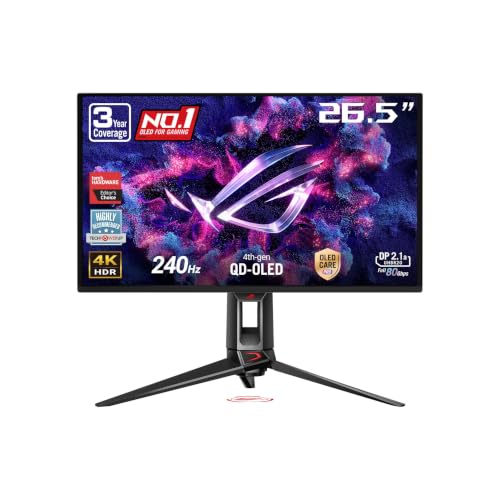
ASUS 27-Inch 4K 240Hz QD-OLED Monitor
Best for: compact 4K high-refresh-rate desktop gaming
- Panel Type
- QD-OLED (what this guide is about)
- Screen Size
- 26.5-inch
- Resolution
- 3840 x 2160
- Refresh Rate
- 240Hz
- Response Time
- 0.03ms
- Connectivity
- DisplayPort 2.1a, USB-C, HDMI 2.1
This monitor pairs a 26.5-inch QD-OLED panel with a 4K UHD resolution of 3840 x 2160 and a 240Hz refresh rate. It delivers a fast 0.03ms response time alongside DisplayPort 2.1a UHBR20 connectivity and a 90W USB-C port. If you want high pixel density and rapid frame rates for fast-paced gaming at your desk, this display fits your setup with built-in proximity-based burn-in protection.
Pros
- DisplayPort 2.1a with full 80Gbps UHBR20 bandwidth
- 240Hz refresh rate paired with a 0.03ms response time
- USB-C port with 90W Power Delivery
- ASUS OLED Care Pro with Neo Proximity Sensor
- Three-year warranty covering burn-in and ARR
Cons
- Standard 16:9 aspect ratio rather than an ultrawide format
- Smaller 26.5-inch visible screen area compared to 32-inch or 34-inch displays
Good fit if
- You need a high pixel density 4K screen with a fast 240Hz refresh rate.
- You want DisplayPort 2.1a UHBR20 bandwidth and 90W USB-C charging.
- You want hardware-level proximity detection to prevent OLED burn-in.
Skip if
- You want a true 21:9 ultrawide aspect ratio for extra horizontal screen space.
- You prefer a larger 32-inch or 34-inch display size.
Verdict: ASUS 27-Inch 4K 240Hz QD-OLED Monitor delivers sharp 4K visuals, high-speed 240Hz performance, and high-bandwidth DisplayPort 2.1a connectivity in a compact desktop size. It is a capable pick if you prioritize extreme pixel density and ultra-low response times over an ultrawide aspect ratio.

ASUS ProArt 27-Inch 4K 120Hz QD-OLED Monitor
Best for: color-critical creative work and multi-PC setups
- Panel Type
- QD-OLED (what this guide is about)
- Screen Size
- 26.5"
- Resolution
- 3840x2160
- Refresh Rate
- 120Hz
- Response Time
- 0.1ms GTG
- Connectivity
- HDMI, DisplayPort, USB-C
View on Amazon: ASUS ProArt 27-Inch 4K 120Hz QD-OLED Monitor
This ASUS ProArt display brings a 26.5-inch 4K UHD QD-OLED panel to your desk with a 120Hz refresh rate and 0.1ms response time. It delivers factory-calibrated Delta E < 1.5 color accuracy, 99% DCI-P3 coverage, and USB-C connectivity with 96W Power Delivery. Built-in Auto KVM and DisplayPort daisy-chaining simplify multi-device setups. It suits you if you need color precision and high pixel density in a compact desktop footprint.
Pros
- 4K UHD QD-OLED panel with factory-calibrated Delta E < 1.5 accuracy
- USB-C port with 96W Power Delivery and DisplayPort daisy-chaining
- Integrated Auto KVM switch for controlling two computers
- Ergonomic stand with full tilt, swivel, pivot, and height adjustability
Cons
- 120Hz refresh rate is lower than dedicated 240Hz gaming alternatives
- Standard 16:9 aspect ratio rather than an ultrawide viewing layout
Good fit if
- You need factory-calibrated color accuracy with 99% DCI-P3 coverage.
- You want a single-cable USB-C connection that supplies up to 96W of power.
- You work across two computers and want built-in Auto KVM switching.
Skip if
- You want a 240Hz panel for competitive fast-motion gaming.
- You require an ultrawide screen with a 21:9 or 32:9 aspect ratio.
Verdict: ASUS ProArt 27-Inch 4K QD-OLED Monitor delivers calibrated 4K visuals, robust 96W USB-C docking, and KVM switching in a standard 27-inch format. It prioritizes color precision and workstation utility over ultra-high gaming refresh rates.

ASUS 27-Inch 4K QD-OLED Gaming Monitor
Best for: compact 4K 240Hz competitive gaming
- Panel Type
- QD-OLED (what this guide is about)
- Screen Size
- 26.5-inch
- Resolution
- 3840 x 2160
- Refresh Rate
- 240Hz
- Response Time
- 0.03ms
- Sync Technology
- G-SYNC Compatible
The ASUS 27-Inch 4K 240Hz QD-OLED Monitor provides a 26.5-inch display with a 3840 x 2160 resolution, a 240Hz refresh rate, and a 0.03ms response time. It delivers 99% DCI-P3 color coverage, VESA DisplayHDR 400 True Black support, and G-SYNC compatibility. If you want high pixel density and fast frame rates on a standard 16:9 screen rather than an ultrawide canvas, this monitor fits your gaming setup.
Pros
- 4K (3840 x 2160) QD-OLED panel with 240Hz refresh rate
- 0.03ms response time and G-SYNC compatibility
- 99% DCI-P3 color coverage and factory Delta E < 2
- ASUS OLED Care Pro with Neo Proximity Sensor
Cons
- Standard 16:9 aspect ratio instead of a 21:9 ultrawide format
- 26.5-inch screen offers less horizontal workspace than larger displays
Good fit if
- You prioritize high 4K pixel density on a 26.5-inch screen.
- You want a 240Hz refresh rate paired with a 0.03ms response time.
- You need 99% DCI-P3 color accuracy with built-in burn-in mitigation features.
Skip if
- You want a panoramic 21:9 ultrawide aspect ratio.
- You prefer a larger 32-inch or 34-inch display size.
Verdict: ASUS 27-Inch 4K 240Hz QD-OLED Monitor delivers high pixel density, rapid 0.03ms response times, and active burn-in protection. It suits players who prefer sharp 16:9 gaming over an ultrawide layout.

ASUS ProArt 32-Inch 4K QD-OLED Monitor
Best for: color-critical creative work and dual-PC setups
- Panel Type
- QD-OLED (what this guide is about)
- Screen Size
- 31.5"
- Resolution
- 3840x2160
- Refresh Rate
- 120Hz
- Response Time
- 0.1ms
- Connectivity
- USB-C, HDMI, DisplayPort
The ASUS ProArt 32-Inch 4K QD-OLED Monitor brings professional color accuracy to a 31.5-inch 3840x2160 panel. You get a 120Hz refresh rate, 0.1ms response time, and 99% DCI-P3 coverage alongside 96W USB-C power delivery and a built-in KVM switch. Unlike the 240Hz gaming models on this list, it balances creator-focused factory calibration with smooth motion. It suits you if you need reliable color fidelity and single-cable laptop docking for creative work.
Pros
- Factory-calibrated Delta E<1.5 with 99% DCI-P3 and 100% sRGB coverage
- USB-C port supplies up to 96W Power Delivery
- Built-in Auto KVM switch and DisplayPort daisy-chain support
- Fully adjustable stand with tilt, swivel, pivot, and height adjustments
Cons
- Standard 16:9 aspect ratio rather than an ultrawide format
- 120Hz refresh rate is lower than dedicated 240Hz gaming alternatives
- HDMI cable is not included in the box
Good fit if
- You prioritize color accuracy with 99% DCI-P3 coverage and Delta E<1.5 calibration.
- You connect a laptop using a single USB-C cable for video and 96W charging.
- You switch between two computers using an integrated Auto KVM.
Skip if
- You want a true 21:9 ultrawide screen rather than a standard 16:9 display.
- You require a 240Hz refresh rate for fast-action competitive gaming.
Verdict: ASUS ProArt 32-Inch 4K QD-OLED Monitor delivers precise factory-calibrated color, 96W USB-C docking, and an integrated KVM for creative workflows. While capped at 120Hz, its 4K panel provides exceptional detail and contrast for precision tasks.

ASUS ROG 34-Inch 240Hz QD-OLED Monitor
Best for: fast ultrawide gaming and standalone streaming
- Panel Type
- QD-OLED (what this guide is about)
- Screen Size
- 34 Inch
- Resolution
- 3440x1440
- Refresh Rate
- 240Hz
- Connectivity
- DisplayPort 1.4, HDMI 2.1, USB-C
- Dimensions
- 4.6 × 31.9 × 21.5 inches
This monitor gives you a 34-inch curved QD-OLED panel running at 3440x1440 with a 240Hz refresh rate. It integrates Google TV streaming, WiFi 6, and 90W USB-C power delivery directly into the chassis alongside standard DisplayPort 1.4 and HDMI 2.1 ports. You also get built-in stereo speakers and a dedicated remote control. It suits you if you want a high-refresh ultrawide setup that doubles as a standalone media display.
Pros
- 3440x1440 QD-OLED panel with 240Hz refresh rate
- USB-C port with 90W Power Delivery and USB hub
- Integrated Google TV with WiFi 6 and included remote
- Dual HDMI 2.1 ports and DisplayPort 1.4 connectivity
Cons
- 1440p resolution rather than 4K
- HDR certification limited to DisplayHDR 400 True Black
Good fit if
- You want a 34-inch ultrawide display running at 240Hz.
- You need 90W USB-C charging for a single-cable laptop connection.
- You plan to stream media directly via built-in Google TV.
Skip if
- You prefer a 4K resolution rather than 3440x1440.
- You want a flat screen instead of a curved ultrawide form factor.
Verdict: ASUS 34-Inch Curved QD-OLED Gaming Monitor delivers fast 240Hz ultrawide gaming alongside standalone Google TV streaming and 90W USB-C connectivity. It provides an all-in-one workstation and entertainment hub for your desk.

ASUS ROG Strix 27-Inch 1440p QD-OLED Monitor
Best for: fast-paced 1440p competitive gaming
- Panel Type
- QD-OLED (what this guide is about)
- Screen Size
- 27 inch
- Resolution
- 2560 x 1440
- Refresh Rate
- 240 Hz
- Response Time
- 0.03 ms
- Sync Technology
- G-SYNC Compatible
View on Amazon: ASUS ROG Strix 27-Inch 1440p QD-OLED Monitor
The ASUS ROG Strix 27-Inch 240Hz QD-OLED Monitor gives you a 2560 x 1440 display paired with a rapid 0.03 ms response time and 240 Hz refresh rate. Its QD-OLED panel covers 99% of the DCI-P3 color space with a Delta E under 2. You also get a Neo Proximity Sensor that turns the screen black when you step away. It suits competitive players seeking smooth motion at standard 1440p resolution.
Pros
- 240 Hz refresh rate and 0.03 ms response time
- 99% DCI-P3 color gamut with Delta E < 2 and true 10-bit color
- Neo Proximity Sensor dims screen when you are away to mitigate burn-in
- G-SYNC Compatible support
Cons
- Standard 16:9 aspect ratio instead of an ultrawide screen format
- No built-in speakers or USB-C display connectivity listed
Good fit if
- You prioritize high-speed 240 Hz gaming with a 0.03 ms response time.
- You want precise colors with 99% DCI-P3 coverage and Delta E < 2 accuracy.
Skip if
- You need an ultrawide aspect ratio or 4K resolution.
- You require integrated audio or USB-C connectivity.
Verdict: ASUS ROG Strix 27-Inch 240Hz QD-OLED Monitor delivers fast 240 Hz motion clarity and accurate colors on a standard 1440p panel. It provides responsive gaming performance, though it lacks an ultrawide screen ratio.
Specifications side by side
| Spec | ASUS 32-Inch 4K QD-OLED Gaming Monitor | ASUS 27-Inch 4K 240Hz QD-OLED Monitor | ASUS ProArt 27-Inch 4K 120Hz QD-OLED Monitor | ASUS 27-Inch 4K QD-OLED Gaming Monitor | ASUS ProArt 32-Inch 4K QD-OLED Monitor | ASUS ROG 34-Inch 240Hz QD-OLED Monitor | ASUS ROG Strix 27-Inch 1440p QD-OLED Monitor |
|---|---|---|---|---|---|---|---|
| Screen Size | 32-inch | 26.5-inch | 26.5" | 26.5-inch | 31.5" | 34 Inch | 27 inch |
| Resolution | 3840 x 2160 | 3840 x 2160 | 3840x2160 | 3840 x 2160 | 3840x2160 | 3440x1440 | 2560 x 1440 |
| Refresh Rate | 240Hz | 240Hz | 120Hz | 240Hz | 120Hz | 240Hz | 240 Hz |
| Panel Type | QD-OLED | QD-OLED | QD-OLED | QD-OLED | QD-OLED | QD-OLED | QD-OLED |
| Response Time | 0.03ms (GTG) | 0.03ms | 0.1ms GTG | 0.03ms | 0.1ms | not specified | 0.03 ms |
| Sync Technology | G-SYNC Compatible | not specified | not specified | G-SYNC Compatible | not specified | not specified | G-SYNC Compatible |
| Connectivity | USB-C | DisplayPort 2.1a, USB-C, HDMI 2.1 | HDMI, DisplayPort, USB-C | not specified | USB-C, HDMI, DisplayPort | DisplayPort 1.4, HDMI 2.1, USB-C | not specified |
| Size | 9.40 | not specified | 27 Inch | not specified | not specified | not specified | 27 pollici |
| Dimensions | 21 × 38 × 49 inches | 8.6 × 24 × 21.6 inches | 7.4 × 24.1 × 16.1 inches | 6.6 × 24.1 × 20.1 inches | 8.74 × 28.3 × 23.9 inches | 4.6 × 31.9 × 21.5 inches | 2.13 × 24.2 × 19.8 inches |
| Weight | 19.4 pounds | 16.8 pounds | 12.4 pounds | 16.4 pounds | 15.5 pounds | 19.4 pounds | 15 pounds |
| Color | BLACK | BLACK | Black/Silver | BLACK | BLACK/SILVER | BLACK | black |
| Model | PG32UCDM | PG27UCDM | PA279CDV | XG27UCDMG | PA329CDV | XG34WCDMTG | 90LM0C80-B01171 |
How to choose the right one
-
Check screen size needs
You must decide between standard and ultrawide formats. Most options here are 27-inch or 32-inch 16:9 panels. The ASUS ROG 34-Inch 240Hz QD-OLED Monitor is the only true ultrawide choice. It offers a wider field of view for immersive gaming. If you prefer a standard aspect ratio, you have several 27-inch and 32-inch models. These provide a more traditional desktop layout. Your desk depth and viewing distance should guide this choice. A larger screen requires more space and viewing distance.
-
Match resolution to GPU
Most monitors in this list use 4K UHD panels. You need a high-end graphics card to drive 4K at high refresh rates. If your GPU is weaker, consider the 34-inch model. It uses a 1440p resolution. This lower resolution is easier for your hardware to handle. The 27-inch 1440p option is also available. It offers a balance between clarity and performance. Always check your graphics card capabilities before buying. A mismatched resolution will result in lower frame rates.
-
Select refresh rate wisely
Refresh rate determines motion smoothness. Most gaming models here offer 240Hz. This is ideal for fast-paced competitive shooters. If you do creative work, 120Hz may suffice. The ASUS ProArt 27-Inch and 32-Inch models run at 120Hz. They prioritize color accuracy over extreme speed. The gaming monitors deliver 240Hz for sharper motion. You should choose based on your primary activity. Fast motion handling is critical for racing and FPS games.
-
Verify connectivity options
Check the ports available on your monitor. Several models include USB-C with power delivery. The ASUS 32-Inch 4K and ProArt models offer 90W or 96W charging. This allows you to connect a laptop and charge it simultaneously. The 34-inch ultrawide also supports 90W USB-C. Other models rely on DisplayPort and HDMI. The 27-inch 4K model features DisplayPort 2.1a. Ensure your devices match the available inputs for a seamless setup.
-
Consider sync technology
Sync technology prevents screen tearing. Most ASUS gaming monitors here support NVIDIA G-SYNC. This ensures smooth gameplay when frame rates fluctuate. The ProArt models focus on color precision. They may not list G-SYNC as a primary feature. If you use an NVIDIA GPU, G-SYNC is essential. It matches the monitor refresh rate to your GPU output. This reduces stuttering and tearing. Check the attributes section to confirm compatibility with your graphics card.
Frequently asked questions
Does the ASUS ROG 34-Inch 240Hz QD-OLED Monitor support Google TV?
Yes, this monitor includes standalone Google TV streaming. You can access apps and content directly on the display without needing a separate device. It also features 90W USB-C connectivity for power delivery. This combination makes it a versatile hub for both gaming and entertainment on your desk.
Which ASUS QD-OLED monitor offers the fastest response time?
The ASUS 27-Inch 4K QD-OLED Gaming Monitor delivers rapid 0.03ms response times. This specification ensures minimal motion blur during fast-paced gameplay. It pairs this speed with a 240Hz refresh rate and G-SYNC compatibility. These specs make it ideal for competitive gaming where every millisecond counts.
Can I use one keyboard and mouse for multiple computers with these monitors?
Yes, the ASUS ProArt 27-Inch 4K 120Hz QD-OLED Monitor includes KVM switching. This feature allows you to control multiple PCs with a single set of peripherals. The ASUS ProArt 32-Inch model also provides an integrated KVM. These tools simplify workflows for users managing dual-PC setups.
What is the difference between the 27-inch and 32-inch 4K models?
The primary difference lies in pixel density and physical footprint. The 27-inch models offer higher pixel density in a compact form factor. The 32-inch option provides a larger viewing area while maintaining 4K resolution. Both sizes utilize QD-OLED panels for superior color accuracy and contrast in desktop environments.
Does the ASUS 32-Inch 4K QD-OLED Gaming Monitor support USB-C?
Yes, it features 90W USB-C connectivity. This port allows you to charge laptops and transfer data simultaneously. It adds versatility to your setup by reducing cable clutter. This connection complements its 240Hz refresh rate and G-SYNC support for high-end gaming and desktop use.
Is there an ASUS QD-OLED monitor with a 1440p resolution?
Yes, the ASUS ROG Strix 27-Inch 1440p QD-OLED Monitor offers this resolution. It delivers fast 240Hz motion clarity on a standard 16:9 panel. This option suits players who prefer 1440p clarity over 4K or ultrawide formats. It maintains accurate colors and responsive performance typical of QD-OLED technology.
Which model is best for color-critical creative work?
The ASUS ProArt 27-Inch 4K 120Hz QD-OLED Monitor is designed for this purpose. It delivers calibrated 4K visuals with precise color reproduction. It also includes 96W USB-C docking for workstation utility. While capped at 120Hz, its focus on color accuracy makes it ideal for professional creative tasks.