ASUS vs LG: Ultrawide Monitors Compared by Specs
As an Amazon Associate we earn from qualifying purchases. Links on this page are affiliate links.
When comparing an ASUS vs LG ultrawide monitor, you will notice they target different needs. The ASUS ROG XG27AQDMGR focuses on high-end gaming with OLED technology. The LG 24U411A-B offers a budget-friendly, practical display for general use. Both brands provide distinct advantages depending on your visual priorities. This guide breaks down their specifications to help you choose the right tool for your desk.
Key differences
| Aspect | LG 24-Inch 120Hz IPS Monitor | ASUS 27-Inch 240Hz Glossy OLED Gaming Monitor |
|---|---|---|
| Screen Size | 27 inch | 24 inch |
| Resolution | 2560 x 1440 | 1920 x 1080 |
| Panel Type | WOLED | IPS |
| Refresh Rate | 240Hz | 120Hz |
| Response Time | 0.03ms | 1ms MBR |
| Connectivity | not listed | HDMI |
Which one should you choose?
Choose LG 24-Inch 120Hz IPS Monitor if
- You prioritize fast motion clarity and deep contrast for competitive gaming
- You want a higher resolution display for detailed visuals
- You value advanced OLED protection features to prevent burn-in
Choose ASUS 27-Inch 240Hz Glossy OLED Gaming Monitor if
- You need a versatile monitor for general productivity and web browsing
- You prefer a smaller footprint for a compact desk setup
- You want a standard IPS panel for consistent color viewing angles
Verdict: The ASUS ROG XG27AQDMGR is the superior choice for gamers who demand high refresh rates and OLED contrast. The LG 24U411A-B serves well for users seeking a reliable, cost-effective display for everyday tasks. Your decision should depend on whether you prioritize gaming performance or general utility.
ASUS vs LG Monitor Specs Compared
Screen size and resolution
The ASUS ROG XG27AQDMGR features a 27-inch display with a QHD resolution of 2560 x 1440 pixels. This setup provides a larger canvas and higher pixel density for sharp visuals. The LG 24U411A-B offers a smaller 24-inch screen with Full HD resolution of 1920 x 1080 pixels. This lower resolution on a smaller panel results in a less detailed image compared to the ASUS. The ASUS delivers significantly more screen real estate and clarity. You get more workspace and finer detail with the ASUS model. The LG is compact but less sharp.
Refresh rate and response time
Speed is a major differentiator between these two monitors. The ASUS ROG XG27AQDMGR boasts a 240Hz refresh rate and an ultra-fast 0.03ms response time. This combination ensures extremely smooth motion and minimal ghosting during fast-paced gaming. The LG 24U411A-B operates at a 120Hz refresh rate with a 1ms Motion Blur Reduction response time. While the LG is adequate for general use, the ASUS offers double the refresh rate and a much faster response. The ASUS provides a superior experience for competitive gaming and high-speed action.
Panel type and color
The panel technology defines the visual quality of each display. The ASUS uses a WOLED panel, which offers true blacks and high contrast ratios. It covers 99% of the DCI-P3 color gamut and supports VESA DisplayHDR 400 True Black. The LG utilizes an IPS panel with up to 99% sRGB coverage and HDR10 support. The OLED technology in the ASUS generally provides better contrast and deeper blacks than the IPS panel in the LG. The ASUS is better for color-critical work and immersive HDR content.
Connectivity and ports
Connectivity options vary between the two models. The LG 24U411A-B lists HDMI as its primary connectivity option. This is standard for general computing and console gaming. The ASUS ROG XG27AQDMGR data does not explicitly list its port types in the provided specifications. However, high-end gaming monitors typically include HDMI and DisplayPort options. Without explicit data for the ASUS ports, we cannot fully compare the variety of connections. The LG offers known HDMI access. You should check the ASUS box for specific port details.
Smart features and software
Software integration differs significantly. The LG 24U411A-B includes a Switch App that allows screen splitting into up to six sections and custom layouts. It also features Dynamic Action Sync to minimize input lag. The ASUS ROG XG27AQDMGR offers the DisplayWidget Center application for mouse-based control and OLED Care Pro functions. It also includes AI-enhanced gaming features. The LG focuses on multitasking efficiency with its split-screen tool. The ASUS focuses on maintenance and AI assistance. The LG is better for productivity workflows.
Which Monitor Suits Your Needs
Fast-paced competitive gamers
The ASUS ROG XG27AQDMGR delivers a 240Hz refresh rate and 0.03ms response time for fluid motion. Its 27-inch QHD OLED panel offers deep blacks and 99% DCI-P3 color coverage. You get VESA DisplayHDR 400 True Black compliance and AI-enhanced gaming features for superior visual clarity and reaction speed.
General office and multitasking users
The LG 24U411A-B provides a 24-inch Full HD IPS display with a 120Hz refresh rate. Its 1ms Motion Blur Reduction ensures smooth visuals for daily tasks. You benefit from a virtually borderless design, HDMI connectivity, and the Switch app for splitting the screen into six sections for efficient multitasking.
Content creators needing color accuracy
The ASUS monitor features true 10-bit color and a Delta E less than 2 for precise color reproduction. With 99% DCI-P3 gamut coverage and OLED technology, it renders vibrant, accurate hues. This makes it ideal for video editing and graphic design where color fidelity is critical for professional output.
The products compared
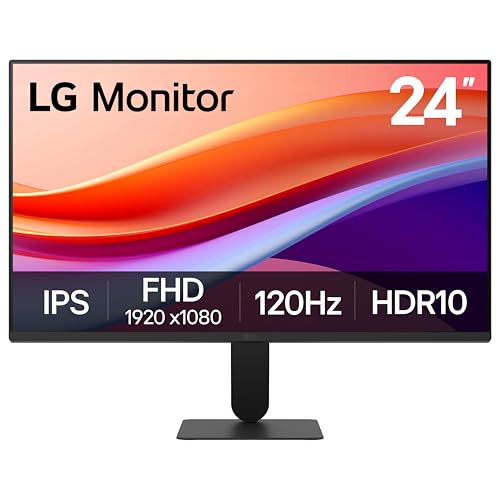
LG 24-Inch 120Hz IPS Monitor
Best for: smooth motion gaming and compact workspaces
- Screen Size
- 24"
- Resolution
- 1920 x 1080
- Refresh Rate
- 120Hz
- Panel Type
- IPS
- Response Time
- 1ms MBR
- Connectivity
- HDMI
View on Amazon: LG 24-Inch 120Hz IPS Monitor Affiliate link
The LG 24U411A is a 24-inch Full HD monitor with an IPS panel and 120Hz refresh rate. It features 1ms Motion Blur Reduction and HDR10 support. The design includes ultra-slim bezels and tilt adjustment. This model suits users who need smooth motion for gaming or clear visuals for productivity. It connects via HDMI and offers 99% sRGB color coverage for vibrant images.
Pros
- 120Hz refresh rate for smoother motion
- 1ms Motion Blur Reduction for crisp gameplay
- 99% sRGB color gamut coverage
- Ultra-slim 3-side borderless design
Cons
- Full HD resolution limits sharpness on larger screens
- Only HDMI connectivity available
- Tilt-only stand lacks height adjustment
Good fit if
- You need a fast refresh rate for gaming
- You prefer a compact 24-inch desk setup
- You want accurate colors for creative work
Skip if
- You require 4K resolution for detailed work
- You need multiple input ports like DisplayPort
- You want height-adjustable stand ergonomics
Verdict: LG 24U411A 24-inch 120Hz IPS Monitor delivers smooth performance and vibrant colors for gamers and professionals who prioritize motion clarity over high resolution.

ASUS 27-Inch 240Hz Glossy OLED Gaming Monitor
Best for: Fast-paced gaming and color-critical tasks
- Screen Size
- 26.5 inch
- Resolution
- 2560 x 1440
- Refresh Rate
- 240Hz
- Panel Type
- WOLED
- Response Time
- 0.03ms GTG
- Sync Technology
- ELMB Sync
View on Amazon: ASUS 27-Inch 240Hz Glossy OLED Gaming Monitor Affiliate link
This 27-inch WOLED monitor delivers QHD resolution with a 240Hz refresh rate and 0.03ms response time. It features VESA DisplayHDR 400 True Black compliance and 99% DCI-P3 color coverage. The display includes OLED Care Pro to mitigate burn-in risks. You get an exclusive control app and a 3-year warranty with burn-in coverage. This setup suits gamers who prioritize speed and color accuracy.
Pros
- 240Hz refresh rate for smooth motion
- 0.03ms response time eliminates ghosting
- 99% DCI-P3 color gamut with Delta E < 2
- OLED Care Pro with Neo Proximity Sensor
- 3-year warranty including burn-in coverage
Cons
- Glossy screen reflects ambient light
- 27-inch size is not ultrawide
- Requires desktop software for full control
Good fit if
- You want the fastest response times available
- You prioritize color accuracy for creative work
- You want protection against OLED burn-in
Skip if
- You need an ultrawide aspect ratio
- You prefer matte displays for bright rooms
- You want wireless connectivity options
Verdict: ASUS ROG XG27AQDMGR 27-inch 240Hz OLED is a high-speed display for competitive gamers who value color precision. It fits users who need fast motion clarity and dedicated burn-in protection.
Specifications side by side
| Spec | LG 24-Inch 120Hz IPS Monitor | ASUS 27-Inch 240Hz Glossy OLED Gaming Monitor |
|---|---|---|
| Screen Size | 24" | 26.5 inch |
| Resolution | 1920 x 1080 | 2560 x 1440 |
| Refresh Rate | 120Hz | 240Hz |
| Panel Type | IPS | WOLED |
| Response Time | 1ms MBR | 0.03ms GTG |
| Sync Technology | not stated | ELMB Sync |
| Connectivity | HDMI | not stated |
| Size | 24 Inch | 14.5" x 23.8" x 2.5" |
| Dimensions | 8.7 × 21.2 × 16.4 inches | 7.4 × 23.8 × 19.7 inches |
| Weight | 7.1 pounds | 14.6 pounds |
| Color | Black | BLACK |
| Model | 24U411A-B.AUSQ | XG27AQDMGR |
Frequently asked questions
Is the ASUS OLED better for gaming than the LG IPS?
Yes, if you prioritize speed and contrast. The ASUS ROG XG27AQDMGR uses a 240Hz refresh rate and OLED panel for faster motion clarity. The LG 24U411A-B uses a 120Hz IPS panel. OLED technology typically offers deeper blacks and faster pixel response times than standard IPS displays.
Which monitor has a higher refresh rate?
The ASUS ROG XG27AQDMGR has the higher refresh rate. It runs at 240Hz. The LG 24U411A-B runs at 120Hz. A higher refresh rate allows for smoother motion in fast-paced games and reduces blur during rapid movement.
Does the LG monitor support ultrawide resolutions?
The provided LG model is not an ultrawide monitor. The LG 24U411A-B has a 24-inch screen size. It does not feature the 21:9 aspect ratio typical of ultrawide displays. You should check other LG models if you require an ultrawide format.
What panel type does the ASUS monitor use?
The ASUS ROG XG27AQDMGR uses an OLED panel. This technology provides high contrast and precise color reproduction. The LG 24U411A-B uses an IPS panel. OLED panels generally offer better viewing angles and deeper black levels compared to IPS.
Which monitor is lighter and easier to move?
The LG 24U411A-B is lighter. It weighs 7.1 pounds. The ASUS ROG XG27AQDMGR weighs 14.6 pounds. If you need a display that is easier to transport or adjust on a desk, the LG model is the more practical choice due to its lower weight.
Are both monitors compatible with HDMI connections?
The LG 24U411A-B explicitly lists HDMI connectivity. The data for the ASUS ROG XG27AQDMGR does not specify its connection types. You should verify the ASUS specifications for HDMI support before purchasing. Always check the input ports on your device to ensure compatibility.
Which screen size is better for competitive gaming?
The ASUS ROG XG27AQDMGR at 27 inches is often preferred for competitive gaming. It offers a 240Hz refresh rate and 1440p resolution. The LG 24U411A-B is smaller at 24 inches with a 120Hz refresh rate. Larger screens with higher refresh rates provide better motion clarity.