LG 24-Inch 120Hz IPS Monitor vs LG 24-Inch UltraGear FHD IPS (2026): Key Differences
As an Amazon Associate we earn from qualifying purchases. Links on this page are affiliate links.
You are comparing the lg 24u411a b 24 inch full HD vs 24g411a b 24 inch ultragear full models. Both offer 24-inch IPS panels with 1080p resolution and 120Hz refresh rates. They share 1ms MBR response times and HDR10 support. The main difference lies in connectivity and gaming features. The UltraGear adds DisplayPort and variable refresh rate support. The standard model focuses on basic productivity with a Switch app.
Key differences
| Aspect | LG 24-Inch 120Hz IPS Monitor | LG 24-Inch UltraGear FHD IPS Gaming Monitor |
|---|---|---|
| Refresh Rate | 120Hz | 120Hz (144Hz O/C) |
| Connectivity | HDMI | HDMI, DisplayPort |
| Sync Technology | not listed | G-SYNC Compatible, AMD FreeSync |
| Dimensions (Height) | 16.4 inches | 16.2 inches |
| Weight | 7.1 pounds | 7.3 pounds |
Which one should you choose?
Choose LG 24-Inch 120Hz IPS Monitor if
- You need a monitor for basic office tasks and web browsing without extra gaming features.
- You prefer a lighter display that is easier to mount or move.
- You want to use the Switch app for screen splitting and multitasking.
Choose LG 24-Inch UltraGear FHD IPS Gaming Monitor if
- You want higher refresh rates up to 144Hz for smoother competitive gaming.
- You need DisplayPort connectivity for your graphics card.
- You require G-SYNC Compatible or FreeSync to eliminate screen tearing.
Verdict: Choose the 24U411A if your priority is simple productivity and a lighter build. Pick the 24G411A if you need DisplayPort, higher overclocked refresh rates, and adaptive sync for gaming. Both deliver the same core visual quality for everyday use.
LG 24U411A vs 24G411A Comparison
Refresh rate ceiling
Product A offers a fixed 120Hz refresh rate. This provides smooth motion for general tasks and casual gaming without requiring configuration. Product B starts at 120Hz but allows overclocking to 144Hz. This higher ceiling reduces motion blur further in fast-paced titles. If you play competitive shooters, the extra 24Hz in Product B can make tracking targets slightly easier. Product A is sufficient for most users, but Product B gives you more headroom if you want to push the panel to its limits. The difference is measurable in high-speed scenes.
Sync technology
Product B includes NVIDIA G-SYNC Compatible and AMD FreeSync support. These technologies synchronize the monitor’s refresh rate with the graphics card’s frame output. This eliminates screen tearing and reduces stuttering during variable frame rates. Product A does not list adaptive sync support in its specifications. Without it, you may experience tearing if your GPU frame rate exceeds the 120Hz limit. Product B is the better choice for gamers who want tear-free visuals across different GPU brands. Product A relies on standard V-Sync or uncapped framerates.
Connectivity options
Product B provides both HDMI and DisplayPort connections. DisplayPort is often required for high refresh rates and adaptive sync features on many systems. It also supports higher bandwidth for future upgrades. Product A lists only HDMI connectivity. While HDMI works for 1080p at 120Hz, you lose the flexibility of DisplayPort. If your graphics card or console relies on DP for optimal performance, Product A might be limiting. Product B covers more bases for PC gamers. Product A is simpler but less versatile for advanced setups.
Gaming features
Product B includes Black Stabilizer and Crosshair overlays. Black Stabilizer brightens dark areas in games, helping you spot enemies in shadowy environments. Crosshair adds a fixed reticle to the center of the screen for precision aiming. Product A lacks these specific gaming-centric on-screen tools. Instead, Product A focuses on productivity with a Switch App for screen splitting. If your priority is immersive gaming mechanics, Product B offers more tactical advantages. Product A is better suited for multitasking and office work.
Physical dimensions
Both monitors share the same width and depth measurements. Product A is slightly taller at 16.4 inches compared to Product B at 16.2 inches. Product A also weighs 7.1 pounds, while Product B weighs 7.3 pounds. The height difference is minimal and unlikely to affect desk placement significantly. The weight difference is negligible. You can mount either monitor on standard VESA arms, though mount compatibility is not explicitly listed for both. The footprint on your desk will be nearly identical for both models. Choose based on preference for slight weight or height variations.
Which LG 24-inch monitor fits you
Competitive FPS gamers seeking max speed
You need the highest possible refresh rate ceiling. This model overclocks to 144Hz, reducing motion blur further than the fixed 120Hz option. It also includes Black Stabilizer for low-light visibility and a Crosshair overlay for precision aiming. These gaming-specific features give you a tactical edge in fast-paced shooters.
Multitaskers who want flexible screen layouts
You prioritize productivity and screen management. This monitor includes the Switch app, allowing you to split the display into up to six sections. You can customize layouts or launch video calls with a single hotkey. This multitasking hub functionality is absent in the gaming-focused alternative, making it better for complex workflows.
Users needing versatile connectivity options
You require DisplayPort in addition to HDMI. This model supports both connection types, offering greater flexibility for connecting various PCs and consoles. The other option lists only HDMI connectivity. Having DisplayPort ensures compatibility with a wider range of modern graphics cards and systems without needing adapters.
The products compared
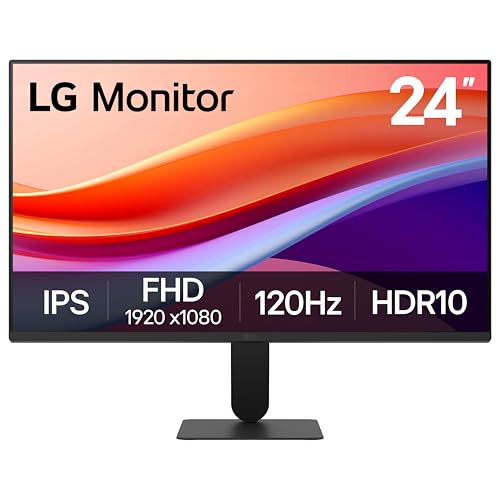
LG 24-Inch 120Hz IPS Monitor
Best for: Light gaming and productivity on a budget
- Screen Size
- 24"
- Resolution
- 1920 x 1080
- Refresh Rate
- 120Hz
- Panel Type
- IPS
- Response Time
- 1ms MBR
- Connectivity
- HDMI
View on Amazon: LG 24-Inch 120Hz IPS Monitor Affiliate link
The LG 24U411A-B is a 24-inch Full HD IPS monitor with a 120Hz refresh rate and 1ms Motion Blur Reduction. It covers 99% of the sRGB gamut and supports HDR10. The design features virtually borderless screens and a tilt-adjustable stand. It includes Dynamic Action Sync for lower input lag. This monitor suits users who want smooth visuals for work and casual gaming.
Pros
- 120Hz refresh rate for smoother motion
- 1ms MBR reduces motion blur
- 99% sRGB color coverage
- HDR10 support for richer contrast
- Dynamic Action Sync minimizes input lag
Cons
- Only HDMI connectivity available
- Limited to 24-inch screen size
- Tilt-only stand adjustment
Good fit if
- You need a high refresh rate for light gaming
- You want accurate colors for general tasks
- You prefer a compact desk footprint
Skip if
- You require multiple input ports
- You need height or pivot adjustments
- You want a larger display for multitasking
Verdict: LG 24U411A-B 24-Inch 120Hz IPS Monitor delivers solid 120Hz performance and color accuracy for users who prioritize smooth motion in a compact 24-inch form factor.

LG 24-Inch UltraGear FHD IPS Gaming Monitor
Best for: competitive FPS gaming on a budget
- Screen Size
- 24"
- Resolution
- 1920 x 1080
- Refresh Rate
- 120Hz (144Hz O/C)
- Panel Type
- IPS
- Response Time
- 1ms MBR
- Sync Technology
- G-SYNC Compatible, AMD FreeSync
View on Amazon: LG 24-Inch UltraGear FHD IPS Gaming Monitor Affiliate link
This LG Ultragear monitor features a 24-inch IPS panel with 1920 x 1080 resolution. It offers a native 120Hz refresh rate, overclocking to 144Hz for smoother motion. The 1ms MBR response time reduces blur in fast scenes. G-SYNC Compatible and FreeSync support ensure tear-free visuals. It targets gamers seeking high refresh rates on a compact screen.
Pros
- IPS panel with 99% sRGB color coverage
- 144Hz overclocked refresh rate for fluid gameplay
- 1ms MBR response time minimizes motion blur
- NVIDIA G-SYNC Compatible and AMD FreeSync support
- Black Stabilizer enhances visibility in dark scenes
Cons
- Lower 1080p resolution compared to 1440p alternatives
- Smaller 24-inch screen size limits immersion
- No mention of USB hub or headphone jack
Good fit if
- You prioritize high refresh rates for competitive gaming
- You need a compact monitor for limited desk space
- You want accurate colors from an IPS panel
Skip if
- You require 4K resolution for detailed work
- You prefer a larger 27-inch or bigger display
- You need built-in speakers or USB connectivity
Verdict: LG 24G411A-B 24-inch 144Hz IPS Gaming Monitor delivers fast refresh rates and accurate colors for competitive play. It suits players who value speed and precision on a small screen.
Specifications side by side
| Spec | LG 24-Inch 120Hz IPS Monitor | LG 24-Inch UltraGear FHD IPS Gaming Monitor |
|---|---|---|
| Screen Size | 24" | 24" |
| Resolution | 1920 x 1080 | 1920 x 1080 |
| Refresh Rate | 120Hz | 120Hz (144Hz O/C) |
| Panel Type | IPS | IPS |
| Response Time | 1ms MBR | 1ms MBR |
| Sync Technology | not stated | G-SYNC Compatible, AMD FreeSync |
| Connectivity | HDMI | HDMI, DisplayPort |
| Size | 24 Inch | 24” |
| Dimensions | 8.7 × 21.2 × 16.4 inches | 8.7 × 21.2 × 16.2 inches |
| Weight | 7.1 pounds | 7.3 pounds |
| Color | Black | Black |
| Model | 24U411A-B.AUSQ | 24G411A-B.AUS |
Frequently asked questions
Does the LG 24G411A support G-Sync?
Yes, the LG 24G411A-B supports G-SYNC compatibility. This feature helps reduce screen tearing and stuttering by synchronizing the monitor's refresh rate with your GPU's frame output. The standard LG 24U411A-B does not list this specific technology in its attributes, making the UltraGear model better for NVIDIA users seeking seamless motion.
Which monitor has more connectivity ports?
The LG 24G411A-B offers more connectivity options. It includes both HDMI and DisplayPort inputs, allowing you to connect multiple devices or use a dedicated graphics card output. The LG 24U411A-B lists only HDMI connectivity, which limits your ability to use DisplayPort for higher bandwidth signals or specific monitor configurations.
Is the LG 24G411A better for competitive gaming?
Yes, the LG 24G411A-B is designed for competitive play. It overclocks to 144Hz, providing a higher refresh rate ceiling than the fixed 120Hz of the 24U411A-B. This extra speed reduces motion blur in fast-paced titles. It also features Black Stabilizer technology to enhance visibility in dark scenes, giving you a tactical edge.
Do both monitors use the same panel type?
Both monitors use IPS panel technology. This ensures wide viewing angles and consistent color reproduction from various positions. You will get accurate colors on both the 24U411A-B and the 24G411A-B. The primary difference lies in their refresh rate capabilities and specific gaming features rather than the underlying panel technology itself.
Which model is lighter?
The LG 24U411A-B is slightly lighter. It weighs 7.1 pounds, while the LG 24G411A-B weighs 7.3 pounds. The difference is minimal at 0.2 pounds. Both monitors have similar dimensions, with the 24U411A-B being marginally taller at 16.4 inches compared to the 24G411A-B's 16.2 inches height.
Can I overclock the LG 24U411A-B?
No, the LG 24U411A-B provides a fixed 120Hz refresh rate. It does not offer an overclocking option to reach higher speeds. If you require a refresh rate above 120Hz, you must choose the LG 24G411A-B, which supports overclocking to 144Hz for smoother motion in supported applications and games.
Is HDR10 supported on both models?
Yes, both monitors support HDR10. This standard allows for a wider range of colors and contrast levels compared to standard SDR content. You will experience improved brightness and detail in compatible media on both the 24U411A-B and the 24G411A-B, though the visual impact depends on your content source and GPU capabilities.