LG vs Amzfast: Ultrawide Monitors Compared by Specs
As an Amazon Associate we earn from qualifying purchases. Links on this page are affiliate links.
This LG vs amzfast ultrawide monitor comparison focuses on two distinct 1080p panels. Both use IPS technology for wide viewing angles and vibrant colors. The main difference lies in their refresh rates and connectivity options. You must decide between a balanced display for mixed use or a high-speed screen built for competitive gaming. We compare their specifications to help you choose the right tool for your desk.
Key differences
| Aspect | LG 24-Inch 120Hz IPS Monitor | Amzfast 25-Inch 320Hz Fast IPS Monitor |
|---|---|---|
| Screen Size | 24 inch | 25 inch |
| Refresh Rate | 120Hz | 320Hz |
| Connectivity | HDMI | 2x HDMI 2.0, 2x DisplayPort 1.4 |
| Sync Technology | Dynamic Action Sync | Adaptive-Sync |
| Color Gamut | 99% sRGB | 120% sRGB |
Which one should you choose?
Choose LG 24-Inch 120Hz IPS Monitor if
- You need a compact monitor for general productivity and casual gaming.
- You prefer a simpler connection setup with HDMI only.
- You want a display with a 1ms Motion Blur Reduction feature for clearer motion.
Choose Amzfast 25-Inch 320Hz Fast IPS Monitor if
- You play competitive first-person shooters and need the highest possible frame rates.
- You require DisplayPort connectivity for higher bandwidth signals.
- You want a wider color gamut for creative work or vivid visuals.
Verdict: The LG monitor suits users who need a versatile, space-saving display for work and light gaming. The Amzfast monitor is the better choice for serious gamers who prioritize speed and connectivity options. Your decision depends on whether you value versatility or raw performance.
LG vs Amzfast Specs Compared
refresh rate speed
The Amzfast monitor leads with a maximum 320Hz refresh rate, designed for ultra-responsive competitive gaming. It also supports 300Hz and 240Hz variants to fit different needs. The LG display offers a 120Hz refresh rate, which provides smoother motion than standard 60Hz panels but falls short of the Amzfast’s top speed. For fast-paced shooters, the higher number on the Amzfast reduces motion blur more effectively. The LG 120Hz is sufficient for casual gaming and general tasks. You get significantly more frames per second with the Amzfast if your graphics card can handle it.
panel technology
Both monitors utilize IPS panels, which are known for wide viewing angles and consistent color reproduction from different positions. The Amzfast specifies a Fast IPS panel, which typically allows for quicker pixel transitions. The LG uses a standard IPS panel. Both support 1ms response times, though the Amzfast lists MPRT while the LG lists MBR. These are different methods of reducing motion blur. The color gamut on the Amzfast covers 120% sRGB, offering vibrant hues. The LG covers up to 99% sRGB. Both deliver good color accuracy for their class, making the panel type a close call for most users.
screen size choice
The LG monitor features a 24-inch screen, while the Amzfast offers a 25-inch display. Both run at 1920 x 1080 resolution. The Amzfast is marketed as an esports size, aiming for an optimal viewing distance for competitive play. The 25-inch panel gives you slightly more real estate than the 24-inch LG. This difference is small but noticeable if you prefer a larger image without increasing pixel density. The LG’s 24-inch size is a classic standard for many desktop setups. You should choose based on your desk space and personal preference for screen real estate.
connectivity options
The Amzfast provides superior connectivity with two DisplayPort 1.4 inputs and two HDMI 2.0 ports. The DisplayPort 1.4 connections support the full 320Hz refresh rate. The HDMI ports are limited to 240Hz at 1080p. The LG monitor only lists HDMI connectivity in its key specs. It does not mention DisplayPort. If you need to connect a console or older PC, HDMI is fine. For high-refresh-rate gaming on a PC, the Amzfast’s DisplayPort support is essential. You get more flexibility and higher performance potential with the Amzfast’s port selection.
ergonomic features
The LG monitor includes a tilt-adjustable stand that allows viewing angles from -5° to 20°. It also features a Switch app for screen splitting and multitasking. The Amzfast mentions an upgraded metal base for stability but does not list tilt adjustment in its specs. The LG offers more direct physical adjustment for your comfort. The Amzfast supports VESA 100x100mm mounting, so you can use a separate arm if needed. The LG’s built-in tilt and software features provide immediate usability without extra accessories. You get better out-of-the-box ergonomics with the LG.
gaming features
The Amzfast includes specific gaming modes for FPS, RTS, and RPG games. It also features an AI crosshair assist, night vision mode, and adaptive sync technology. These tools are designed to give competitive players an edge. The LG focuses on general motion clarity with Dynamic Action Sync to minimize input lag. It also offers HDR10 support and Reader Mode for eye comfort. The Amzfast’s feature set is more tailored to hardcore gamers. The LG is better for mixed use, balancing gaming with productivity. You should pick the Amzfast if you play competitive titles frequently.
Which Ultrawide Monitor Fits Your Needs
Competitive FPS gamers needing high speed
The Amzfast monitor delivers a 320Hz refresh rate, offering superior motion clarity for fast-paced titles. Its Fast IPS panel ensures rapid response times. The included DisplayPort 1.4 connections support these high frame rates effectively, giving you a competitive edge in esports environments where every millisecond counts.
Office workers valuing multitasking features
The LG display includes a dedicated Switch app that splits your screen into six sections. This allows you to manage multiple windows for work or streaming effortlessly. The 120Hz refresh rate provides smooth visuals for general productivity, while the HDMI connectivity offers simple setup for standard office equipment.
Users seeking balanced color accuracy
The Amzfast model covers 120% of the sRGB color gamut, providing vibrant and accurate colors for creative tasks. It also features HDR10 support and TÜV Rheinland certification for low blue light. These specs make it suitable for designers or media consumers who prioritize visual fidelity alongside gaming performance.
The products compared
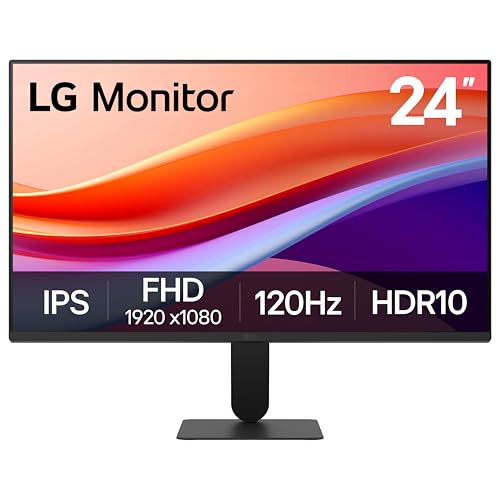
LG 24-Inch 120Hz IPS Monitor
Best for: Smooth motion and multi-window productivity
- Screen Size
- 24"
- Resolution
- 1920 x 1080
- Refresh Rate
- 120Hz
- Panel Type
- IPS
- Response Time
- 1ms MBR
- Connectivity
- HDMI
View on Amazon: LG 24-Inch 120Hz IPS Monitor Affiliate link
This 24-inch LG monitor uses an IPS panel for 1920 x 1080 resolution and 120Hz refresh rate. It features 1ms Motion Blur Reduction and HDR10 support with 99% sRGB coverage. The Switch app allows screen splitting into six sections. It includes HDMI connectivity and tilt adjustment. This setup suits users who need clear visuals and smooth motion for productivity or casual gaming.
Pros
- 120Hz refresh rate for smoother motion
- IPS panel with 99% sRGB color gamut
- 1ms Motion Blur Reduction (MBR)
- Switch app enables up to 6-way screen splitting
- HDR10 support for vivid colors
Cons
- 1080p resolution limits sharpness on larger screens
- Only HDMI connectivity available
- Tilt-only stand lacks height adjustment
Good fit if
- You need a high refresh rate for smooth motion
- You want accurate colors for creative work
- You prefer multi-window productivity layouts
Skip if
- You require 4K resolution for detailed text
- You need multiple input ports like DisplayPort
- You want ergonomic height adjustment
Verdict: LG 24U411A 24-inch 120Hz IPS Monitor delivers smooth 120Hz visuals and precise color for users who prioritize motion clarity and multitasking over high resolution.

Amzfast 25-Inch 320Hz Fast IPS Monitor
Best for: competitive esports players wanting 320Hz refresh rates
- Screen Size
- 25"
- Resolution
- 1080p
- Refresh Rate
- 320Hz
- Panel Type
- Fast IPS
- Response Time
- 1ms MPRT
- Sync Technology
- Adaptive-Sync
View on Amazon: Amzfast 25-Inch 320Hz Fast IPS Monitor Affiliate link
This 25-inch monitor gives you a Fast IPS panel with a 320Hz refresh rate and a 1ms MPRT response time at 1080p resolution. It features two DisplayPort 1.4 ports, two HDMI 2.0 ports, and Adaptive-Sync support. If you play fast-paced competitive esports titles and prioritize high frame rates over screen size or ultra-high pixel density, this display fits your setup.
Pros
- 320Hz maximum refresh rate via DisplayPort 1.4
- 1ms MPRT Fast IPS panel
- 120% sRGB color gamut coverage
- Adaptive-Sync tear-free visual support
Cons
- HDMI 2.0 connections max out at 240Hz instead of 320Hz
- 1080p native resolution rather than 1440p or 4K
Good fit if
- You want up to 320Hz refresh rates for competitive esports titles.
- You need multiple DisplayPort 1.4 and HDMI 2.0 display inputs.
- You mount your display using a standard VESA 100x100mm bracket.
Skip if
- You require resolutions higher than 1080p for fine graphic detail.
- You plan to reach 320Hz exclusively over an HDMI connection.
Verdict: Amzfast 25-Inch 320Hz Fast IPS Gaming Monitor serves competitive gamers who demand maximum frame rates at 1080p through DisplayPort. It delivers smooth esports performance without taking up excessive desk space.
Specifications side by side
| Spec | LG 24-Inch 120Hz IPS Monitor | Amzfast 25-Inch 320Hz Fast IPS Monitor |
|---|---|---|
| Screen Size | 24" | 25" |
| Resolution | 1920 x 1080 | 1080p |
| Refresh Rate | 120Hz | 320Hz |
| Panel Type | IPS | Fast IPS |
| Response Time | 1ms MBR | 1ms MPRT |
| Sync Technology | not stated | Adaptive-Sync |
| Connectivity | HDMI | 2x HDMI 2.0, 2x DisplayPort 1.4 |
| Size | 24 Inch | 25 Inch |
| Dimensions | 8.7 × 21.2 × 16.4 inches | 8.66 × 21.9 × 17 inches |
| Weight | 7.1 pounds | not stated |
| Color | Black | White |
| Model | 24U411A-B.AUSQ | AMZG25F6F-FR0C |
Frequently asked questions
Which monitor is better for multitasking?
The LG 24U411A is better for multitasking. It features a 24-inch IPS panel that offers precise color and smooth 120Hz motion. This size and refresh rate balance well for productivity tasks. The Amzfast 25-inch model targets competitive gaming with a 320Hz rate, making it less ideal for steady, long-form work.
Does the Amzfast monitor support DisplayPort?
Yes, the Amzfast 25-inch monitor supports DisplayPort. This connectivity option helps achieve its high 320Hz refresh rate. The LG 24-inch model lists HDMI as its primary connection. If you need DisplayPort for high-speed gaming signals, the Amzfast unit is the correct choice for your setup.
What is the panel type for both brands?
Both monitors use IPS panel technology. The LG 24U411A utilizes IPS for vibrant colors and wide viewing angles. The Amzfast 25-inch model also employs an IPS panel, described as Fast IPS. This shared technology ensures good color accuracy and consistent image quality from different viewing positions on both displays.
How heavy is the LG 24-inch monitor?
The LG 24U411A weighs 7.1 pounds. Its dimensions are 21.2 inches wide, 16.4 inches high, and 8.7 inches long. This weight and size make it suitable for standard desk setups. The Amzfast model is slightly larger at 21.9 inches wide and weighs less, though its exact weight is not specified in the data.
Is the LG monitor suitable for esports?
The LG 24U411A is less suitable for high-level esports. It offers a 120Hz refresh rate, which is smooth but slower than competitive standards. The Amzfast monitor provides a 320Hz refresh rate, designed specifically for ultra-responsive competitive gaming. If you prioritize frame rates over color precision, the Amzfast unit is the better option.
What resolution do these monitors use?
Both monitors use 1080p resolution. The Amzfast 25-inch model is explicitly listed as a 1080p display. The LG 24-inch model shares this resolution class, focusing on motion clarity rather than high pixel density. Neither unit offers ultrawide or 4K resolution, keeping the focus on refresh rate and panel speed.
Which brand offers a higher refresh rate?
Amzfast offers the higher refresh rate. Its 25-inch monitor reaches 320Hz, with support for 300Hz and 240Hz variants. The LG 24-inch monitor tops out at 120Hz. If your priority is minimizing input lag and maximizing frame rates for fast-paced titles, the Amzfast specification clearly exceeds the LG performance metrics.