LG vs Dell Ultrawide Monitors: Which Brand Fits You?
As an Amazon Associate we earn from qualifying purchases. Links on this page are affiliate links.
When you compare an LG vs dell ultrawide monitor, you notice both use IPS panels for good color. The LG 24U411A-B offers a 24-inch screen with 120Hz refresh. The Dell SE2726HG provides a larger 27-inch display with 240Hz refresh. Both target productivity and casual gaming. The main difference lies in screen size and maximum refresh rate. You must decide which balance of speed and space fits your desk.
Key differences
| Aspect | LG 24-Inch 120Hz IPS Monitor | Dell 27-Inch 240Hz IPS Gaming Monitor |
|---|---|---|
| Screen Size | 24 inches | 27 inches |
| Refresh Rate | 120Hz | 240Hz |
| Response Time | 1ms MBR | 0.5ms |
| Sync Technology | not listed | AMD FreeSync Premium |
| Connectivity | HDMI | HDMI, DisplayPort 1.4 |
Which one should you choose?
Choose LG 24-Inch 120Hz IPS Monitor if
- You need a compact 24-inch monitor for tight desks
- You want built-in multitasking screen splitting via the Switch app
- You prefer a lighter display that is easier to move
Choose Dell 27-Inch 240Hz IPS Gaming Monitor if
- You want a larger 27-inch canvas for more workspace
- You play competitive games requiring 240Hz refresh rates
- You need DisplayPort connectivity for your PC setup
Verdict: Choose the LG if you prioritize a compact footprint and software multitasking features. Pick the Dell if you need a larger screen and higher refresh rates for faster gaming. Both offer solid IPS color performance for daily tasks.
LG vs Dell Monitor Specs
Screen size
The Dell SE2726HG features a 27-inch display, while the LG 24U411A-B has a 24-inch panel. You gain extra screen real estate with the Dell, which helps when you need more workspace for multitasking or want a larger gaming view. The LG offers a more compact footprint that fits smaller desks better. Both monitors use Full HD resolution, so the pixel density is higher on the smaller LG screen. If you prefer a larger visual field without moving closer to the desk, the Dell provides that advantage. The LG remains a solid choice if desk space is limited.
Refresh rate
Refresh rate determines how many times per second the image updates. The Dell SE2726HG supports a 240Hz refresh rate, which is significantly faster than the LG 24U411A-B's 120Hz. For fast-paced gaming, the higher refresh rate on the Dell results in smoother motion and less stutter. You will notice the difference in competitive shooters or racing games where frame transitions matter. The LG 120Hz is still smooth for everyday tasks and casual gaming, but the Dell offers superior fluidity. If you prioritize high-speed visual performance, the Dell has the clear edge.
Response time
Response time measures how quickly a pixel changes color. The Dell SE2726HG lists a 0.5ms response time, whereas the LG 24U411A-B specifies 1ms Motion Blur Reduction. Both times are fast enough to prevent noticeable ghosting during normal use. The Dell's 0.5ms figure is technically quicker, which aligns with its 240Hz panel. This lower number helps maintain clarity during rapid movements. The LG uses MBR technology to reduce blur, which is effective for its 120Hz speed. For most users, both monitors will feel responsive, but the Dell has a slight technical advantage in raw pixel transition speed.
Connectivity
Connectivity options determine what devices you can link to the monitor. The Dell SE2726HG includes both HDMI and DisplayPort 1.4 inputs. This allows you to connect a PC via DisplayPort for full refresh rates and a console via HDMI. The LG 24U411A-B lists only HDMI connectivity in its key specs. If you need to connect a graphics card using DisplayPort, the Dell is the only viable option. The LG works fine for HDMI-only setups, but the Dell offers greater flexibility for different hardware configurations.
Sync technology
Sync technology prevents screen tearing by matching the monitor's refresh rate to the graphics card's output. The Dell SE2726HG supports AMD FreeSync Premium, which ensures smooth gameplay without tearing. The LG 24U411A-B mentions Dynamic Action Sync to minimize input lag, but it does not list a specific variable refresh rate standard like FreeSync or G-Sync. FreeSync Premium provides a guaranteed experience for compatible AMD cards. The LG's feature focuses more on reducing delay than syncing frame rates. For tearing-free gaming, the Dell's certified sync technology is the stronger choice.
Color accuracy
Both monitors cover 99% of the sRGB color gamut, which is standard for good color reproduction in this segment. The Dell SE2726HG highlights excellent color accuracy across wide viewing angles due to its Fast IPS panel. The LG 24U411A-B also uses an IPS panel with HDR10 support, aiming for vivid colors. Since both share the same sRGB coverage, they will look similar in terms of color richness. The Dell emphasizes accuracy, while the LG adds HDR10 for supported content. For general color fidelity, this is a tie, as both deliver strong performance for their class.
Which LG or Dell Monitor Fits You
Competitive gamers needing top speed
The Dell SE2726HG delivers a 240Hz refresh rate and 0.5ms response time. This setup minimizes input lag and eliminates screen tearing via FreeSync Premium. You get fluid motion and precise tracking for fast-paced titles, giving you a clear advantage in competitive scenarios where every millisecond counts.
Office workers valuing multitasking software
The LG 24U411A-B includes the Switch app for efficient workflow management. You can split your screen into six sections to handle multiple tasks simultaneously. The 120Hz refresh rate ensures smooth cursor movement, while the tilt-adjustable stand helps you find a comfortable viewing angle for long work sessions.
Users prioritizing eye comfort and color
The Dell SE2726HG holds TÜV Rheinland certification for lower blue light emission without sacrificing color quality. It also covers 99% of the sRGB gamut. You benefit from accurate, vivid imagery that reduces eye strain during extended use, making it a solid choice for both creative work and general browsing.
The products compared
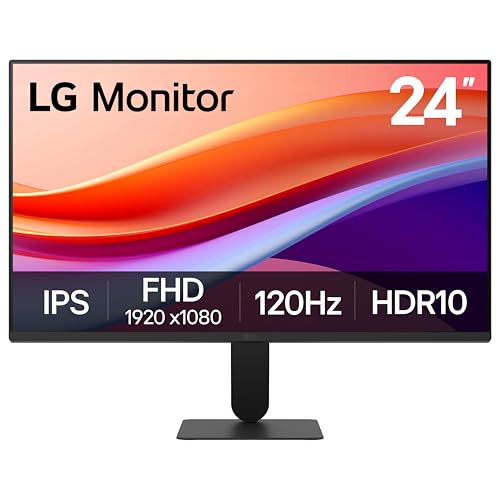
LG 24-Inch 120Hz IPS Monitor
Best for: Light gaming and productivity on a budget
- Screen Size
- 24"
- Resolution
- 1920 x 1080
- Refresh Rate
- 120Hz
- Panel Type
- IPS
- Response Time
- 1ms MBR
- Connectivity
- HDMI
View on Amazon: LG 24-Inch 120Hz IPS Monitor Affiliate link
This LG 24U411A-B is a 24-inch Full HD IPS monitor with a 120Hz refresh rate. It features 1ms Motion Blur Reduction and HDR10 support with 99% sRGB coverage. The design includes virtually borderless bezels and tilt adjustment. It suits users needing smooth motion for light gaming and clear visuals for productivity tasks in a compact form factor.
Pros
- 120Hz refresh rate for smoother motion
- 1ms Motion Blur Reduction for crisp gameplay
- 99% sRGB color gamut coverage
- Virtually borderless 3-side design
- HDR10 support for vivid color
Cons
- Limited to 1920 x 1080 resolution
- Only HDMI connectivity available
- Tilt-only stand adjustment
Good fit if
- You want a smooth 120Hz experience on a budget
- You need accurate colors for casual creative work
- You prefer a compact 24-inch desk setup
Skip if
- You require 4K or ultrawide resolution
- You need multiple input ports like DisplayPort
- You want height or swivel adjustments
Verdict: LG 24U411A-B 24-inch 120Hz IPS Monitor delivers solid motion clarity and color accuracy for casual gamers and office workers. It fits buyers who prioritize refresh rate and screen real estate over high resolution or advanced ergonomics.

Dell 27-Inch 240Hz IPS Gaming Monitor
Best for: competitive gamers seeking speed and color
- Screen Size
- 27"
- Resolution
- 1920x1080
- Refresh Rate
- 240Hz
- Panel Type
- Fast IPS
- Response Time
- 0.5ms
- Sync Technology
- AMD FreeSync Premium
View on Amazon: Dell 27-Inch 240Hz IPS Gaming Monitor Affiliate link
The Dell SE2726HG is a 27-inch Fast IPS monitor designed for high-speed gaming. It features a 240Hz refresh rate and a 0.5ms response time to reduce motion blur. The display covers 99% of the sRGB color space and includes AMD FreeSync Premium to prevent screen tearing. It connects via HDMI and DisplayPort 1.4. This model suits players who prioritize speed and color accuracy over high resolution.
Pros
- 240Hz refresh rate for fluid motion
- 0.5ms response time reduces input lag
- 99% sRGB color coverage for vivid imagery
- AMD FreeSync Premium eliminates tearing
Cons
- Full HD resolution on a 27-inch screen lowers pixel density
- No USB hub or built-in speakers listed
- Only 240Hz variant available in this model line
Good fit if
- You play competitive shooters and need high refresh rates
- You prefer Fast IPS panels for better viewing angles
- You want strong color accuracy without 4K cost
Skip if
- You need ultrawide aspect ratios for productivity
- You require 4K resolution for sharp text
- You want a monitor with built-in speakers
Verdict: Dell 27-inch 240Hz FHD Gaming Monitor delivers the speed and color performance needed for competitive play. It fits buyers who value high refresh rates and Fast IPS quality over screen real estate or resolution.
Specifications side by side
| Spec | LG 24-Inch 120Hz IPS Monitor | Dell 27-Inch 240Hz IPS Gaming Monitor |
|---|---|---|
| Screen Size | 24" | 27" |
| Resolution | 1920 x 1080 | 1920x1080 |
| Refresh Rate | 120Hz | 240Hz |
| Panel Type | IPS | Fast IPS |
| Response Time | 1ms MBR | 0.5ms |
| Sync Technology | not stated | AMD FreeSync Premium |
| Connectivity | HDMI | HDMI, DisplayPort 1.4 |
| Size | 24 Inch | SE2725HG |
| Dimensions | 8.7 × 21.2 × 16.4 inches | 7.4 × 24.1 × 17.8 inches |
| Weight | 7.1 pounds | 8.2 pounds |
| Color | Black | Black |
| Model | 24U411A-B.AUSQ | SE2726HG |
Frequently asked questions
Does LG offer a faster refresh rate than Dell in this lineup?
No. The Dell SE2726HG provides a 240Hz refresh rate, which is significantly faster than the LG 24U411A-B's 120Hz. You choose Dell if you prioritize smooth motion for competitive gaming. The LG model suits casual use where 120Hz is sufficient.
Which monitor has the larger screen size?
The Dell SE2726HG has the larger 27-inch display. The LG 24U411A-B features a smaller 24-inch panel. You get more workspace and a larger gaming field with the Dell. The LG is better if you prefer a more compact setup.
Are both monitors using IPS panel technology?
Yes. Both the LG 24U411A-B and the Dell SE2726HG use IPS panels. This ensures you get good color accuracy and wide viewing angles on both devices. You can rely on consistent image quality from either brand for productivity or gaming.
Does the Dell monitor support FreeSync?
Yes. The Dell SE2726HG includes FreeSync sync technology. This helps eliminate screen tearing and stuttering during fast-paced gameplay. The LG 24U411A-B data does not list this feature, so you should verify its compatibility if tearing is a concern.
Which monitor is lighter to move around?
The LG 24U411A-B is lighter at 7.1 pounds. The Dell SE2726HG weighs 8.2 pounds. You will find the LG easier to carry or adjust on your desk. The Dell is slightly heavier due to its larger 27-inch frame and stand.
What connectivity ports are available on the Dell monitor?
The Dell SE2726HG offers both DisplayPort and HDMI connections. This gives you flexibility in linking to various devices. The LG 24U411A-B lists HDMI connectivity. You should check your specific cable needs before choosing between the two brands.
Is the LG monitor suitable for budget-conscious buyers?
Yes. The LG 24U411A-B is positioned for light gaming and productivity on a budget. It delivers solid motion clarity and color accuracy for casual users. You get good value if you prioritize refresh rate and basic screen real estate over high resolution.