LG or Msi? Ultrawide Monitors Compared in 2026
As an Amazon Associate we earn from qualifying purchases. Links on this page are affiliate links.
You are comparing an LG vs msi ultrawide monitor selection, though both units here are 24-inch Full HD displays. They share IPS panels and tilt-adjustable stands for comfortable viewing. The main difference lies in performance and connectivity. The LG offers a 120Hz refresh rate with HDR10 and a dedicated multitasking app. The MSI provides a faster 144Hz refresh rate, FreeSync support, and legacy VGA connectivity. Both target productivity and casual gaming with clear, sharp visuals.
Key differences
| Aspect | LG 24-Inch 120Hz IPS Monitor | MSI 24-Inch 144Hz FHD IPS Monitor |
|---|---|---|
| Refresh Rate | 120Hz | 144Hz |
| Sync Technology | Dynamic Action Sync | FreeSync |
| HDR Support | HDR10 | HDR Ready |
| Connectivity | HDMI | HDMI 2.0, D-Sub (VGA) |
| Special Features | Switch App, 1ms MBR | Eye-Q Check, Firmware Updates |
Which one should you choose?
Choose LG 24-Inch 120Hz IPS Monitor if
- You want HDR10 support for richer color in compatible content
- You prefer built-in screen-splitting tools for multitasking
- You value a lighter monitor for easier desk placement
Choose MSI 24-Inch 144Hz FHD IPS Monitor if
- You need a higher 144Hz refresh rate for smoother motion
- You require a VGA port for older computer systems
- You want FreeSync to prevent screen tearing during gaming
Verdict: Choose the LG if you prioritize multitasking software and HDR10 color support. The MSI is the better fit if you need a higher refresh rate and legacy VGA connectivity. Both models deliver sharp Full HD visuals on IPS panels for general use.
LG vs MSI Monitor Specs
Refresh rate
The MSI PRO MP243L E14 features a 144Hz refresh rate, while the LG 24U411A-B offers 120Hz. Both panels use IPS technology for wide viewing angles and accurate colors. The higher refresh rate on the MSI unit allows for smoother motion in fast-paced games, reducing stutter and tearing. This 24Hz difference provides a tangible advantage for competitive gaming. You will notice more fluid frame transitions on the MSI display. The LG remains capable for general use and casual gaming, but the MSI leads in raw motion clarity.
Sync technology
Sync technology helps match the monitor's refresh rate to your graphics card's output. The MSI monitor supports FreeSync, which eliminates screen tearing and stuttering across a range of frame rates. The LG specifications list Dynamic Action Sync to minimize input lag, but do not explicitly mention FreeSync or G-Sync compatibility. FreeSync is a standard feature for smooth gaming on the MSI. If you use an AMD card or want broad compatibility, the MSI has the clear advantage here. The LG lacks this specific named technology in the provided data.
Color accuracy
Color performance is critical for creative work and immersive gaming. The LG 24U411A-B specifies up to 99% sRGB color gamut coverage and includes HDR10 support. This ensures vivid, accurate colors across a wide spectrum for everyday tasks and media. The MSI monitor is described as having accurate colors and HDR Ready status, but it does not list a specific sRGB percentage. The LG provides concrete data on its color range. For users who prioritize verified color fidelity, the LG offers more detailed specifications to rely on.
Connectivity
Input options vary between these two 24-inch displays. The MSI PRO MP243L E14 includes both HDMI 2.0 and a D-Sub (VGA) port. This legacy VGA connection supports older computers and consoles that lack digital outputs. The LG 24U411A-B lists only HDMI connectivity. If you need to connect vintage hardware or a PC with a VGA output, the MSI is the only choice. The LG is sufficient for modern devices with HDMI ports. The MSI wins for broader compatibility with older systems.
Software features
Both monitors include software tools to enhance your experience. The LG offers the Switch App, which splits the screen into up to six sections for multitasking and allows launching video calls with a single hotkey. The MSI includes Eye-Q Check for vision assessment and supports firmware updates for performance optimizations. The LG's multitasking features are more directly useful for daily productivity and office work. The MSI focuses on health checks and long-term maintenance. For users who frequently split screens, the LG provides more practical utility.
Choose the best 24-inch monitor for you
Competitive gamers needing smooth visuals
The MSI PRO MP243L E14 offers a 144Hz refresh rate, which provides smoother motion than the LG's 120Hz panel. It includes FreeSync technology to eliminate screen tearing and stuttering. The 1ms response time ensures fast tracking in fast-paced games. These specs help you maintain focus and react quickly without visual distractions.
Users wanting multitasking software features
The LG 24U411A-B includes the Switch app, which splits your screen into up to six sections. This feature helps you manage multiple windows for work or streaming. It also supports HDR10 and covers up to 99% of the sRGB color gamut. This combination aids productivity and delivers vibrant visuals for creative tasks or everyday browsing.
Those needing legacy port connectivity
The MSI monitor provides both HDMI 2.0 and a D-Sub (VGA) port. This allows you to connect older computers or legacy hardware alongside modern devices. The LG model lists only HDMI connectivity. If you rely on older systems or specific legacy adapters, the MSI unit offers the necessary compatibility without requiring extra adapters.
People prioritizing lighter weight setup
The LG monitor weighs 7.1 pounds, making it lighter than the MSI option. This reduced weight can be easier to handle during installation or if you plan to move the display frequently. The LG also features a floating stand design with ultra-slim bezels. This creates a cleaner look for dual setups or clutter-free desks.
The products compared
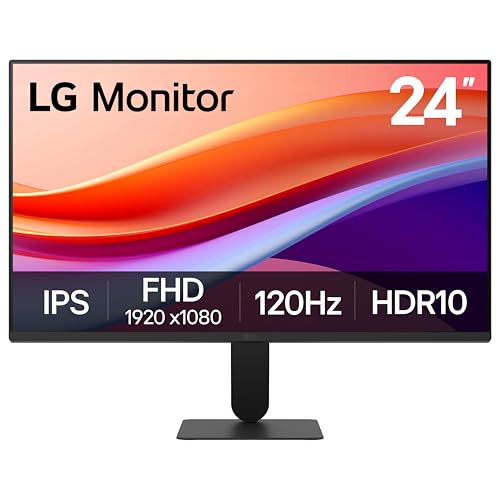
LG 24-Inch 120Hz IPS Monitor
Best for: Smooth motion and multitasking on a small screen
- Screen Size
- 24"
- Resolution
- 1920 x 1080
- Refresh Rate
- 120Hz
- Panel Type
- IPS
- Response Time
- 1ms MBR
- Connectivity
- HDMI
View on Amazon: LG 24-Inch 120Hz IPS Monitor Affiliate link
This 24-inch LG monitor offers Full HD resolution on an IPS panel with a 120Hz refresh rate. It features 1ms Motion Blur Reduction and HDR10 support for clearer visuals. The Switch app allows screen splitting for multitasking. It includes Flicker Safe technology and HDMI connectivity. This display suits users needing smooth motion and color accuracy in a compact form factor.
Pros
- 120Hz refresh rate for smoother motion
- IPS panel with 99% sRGB coverage
- 1ms Motion Blur Reduction (MBR)
- Switch app for screen splitting
- HDR10 support
Cons
- Full HD resolution on a 24-inch screen
- Only HDMI connectivity listed
- Tilt-adjustable stand only
Good fit if
- You need a 120Hz refresh rate for gaming
- You want IPS color accuracy for creative work
- You prefer a compact 24-inch desk setup
Skip if
- You require 4K resolution clarity
- You need multiple input ports like DisplayPort
- You want height-adjustable stand ergonomics
Verdict: LG 24U411A 24-inch 120Hz IPS Monitor delivers solid motion handling and color for casual gaming and productivity. It fits users who prioritize smooth visuals and multitasking features in a small footprint.

MSI 24-Inch 144Hz FHD IPS Monitor
Best for: Standard desktop gaming and office work
- Screen Size
- 24-inch
- Resolution
- 1920 x 1080
- Refresh Rate
- 144Hz
- Panel Type
- IPS
- Response Time
- 1ms
- Sync Technology
- Free Sync
View on Amazon: MSI 24-Inch 144Hz FHD IPS Monitor Affiliate link
The MSI PRO MP243L E14 is a 24-inch Full HD IPS monitor with a 144Hz refresh rate. It features a 1ms response time and FreeSync technology to reduce screen tearing. The display offers wide viewing angles and includes TÜV Rheinland certification for flicker-free and low blue light performance. This model suits users who need smooth motion for gaming and clear visuals for office work on a standard desk setup.
Pros
- 144Hz refresh rate for smooth motion
- IPS panel with 178° viewing angles
- 1ms response time for fast tracking
- TÜV Rheinland certified flicker-free display
- FreeSync eliminates screen tearing
Cons
- 1920 x 1080 resolution is not ultrawide
- Limited to HDMI 2.0 and VGA ports
- Tilt-only stand lacks height adjustment
Good fit if
- You want a 144Hz refresh rate for smoother gameplay
- You need wide viewing angles for shared screens
- You prefer flicker-free technology for eye comfort
Skip if
- You require an ultrawide aspect ratio
- You need 4K resolution for detailed text
- You want a monitor with height-adjustable stands
Verdict: The MSI PRO MP243L E14 24-inch 144Hz Monitor delivers reliable performance for standard desktops. It fits users who prioritize smooth motion and eye comfort over high resolution or ultrawide formats.
Specifications side by side
| Spec | LG 24-Inch 120Hz IPS Monitor | MSI 24-Inch 144Hz FHD IPS Monitor |
|---|---|---|
| Screen Size | 24" | 24-inch |
| Resolution | 1920 x 1080 | 1920 x 1080 |
| Refresh Rate | 120Hz | 144Hz |
| Panel Type | IPS | IPS |
| Response Time | 1ms MBR | 1ms |
| Sync Technology | not stated | Free Sync |
| Connectivity | HDMI | HDMI 2.0, D-Sub (VGA) |
| Size | 24 Inch | not stated |
| Dimensions | 8.7 × 21.2 × 16.4 inches | 7.13 × 21.3 × 15.7 inches |
| Weight | 7.1 pounds | 9.5 pounds |
| Color | Black | Black |
| Model | 24U411A-B.AUSQ | PRO MP243L E14 |
Frequently asked questions
Which monitor has a higher refresh rate?
The MSI PRO MP243L E14 features a 144Hz refresh rate. This is higher than the LG 24U411A-B, which offers 120Hz. Both panels use IPS technology for wide viewing angles and accurate colors. The higher refresh rate on the MSI unit allows for smoother motion in fast-paced games.
Do these monitors have VGA ports?
Yes, the MSI PRO MP243L E14 includes VGA connectivity. This allows you to connect older computers or laptops that lack HDMI outputs. The LG 24U411A-B lists only HDMI connectivity. You must check your device ports before purchasing the LG model if you only have VGA cables.
Are both displays IPS panels?
Yes, both monitors use IPS panel technology. This ensures wide viewing angles and consistent color reproduction from different positions. You will not see significant color shifting if you view the screen from the side. This makes both options suitable for shared workspaces or casual gaming sessions.
Which unit is lighter?
The LG 24U411A-B is lighter at 7.1 pounds. The MSI PRO MP243L E14 weighs 9.5 pounds. If you plan to move the monitor frequently or mount it on a lightweight arm, the LG model offers a smaller footprint and less mass to support.
Can I use these for multitasking?
Both units are designed for multitasking and productivity. The LG model is specifically noted for smooth visuals and multitasking features in a small footprint. The MSI unit supports standard desktop work with reliable performance. You can run multiple windows side-by-side on either 24-inch Full HD display.
What is the model number for the MSI monitor?
The specific model for the MSI monitor is PRO MP243L E14. You can use this number to find exact specifications or drivers online. The LG model is identified as 24U411A-B.AUSQ. Keep these codes handy when comparing exact regional variations or accessory compatibility.
Do these monitors support FreeSync?
The MSI PRO MP243L E14 includes FreeSync technology. This feature helps eliminate screen tearing and stuttering during gameplay. The provided data for the LG 24U411A-B does not explicitly mention FreeSync support. You should verify this detail on the manufacturer's official page if tear-free gaming is a priority.
Are the stands adjustable?
Both monitors feature tilt-adjustable stands for comfortable viewing. You can angle the screen up or down to reduce neck strain. Neither unit is described as having height adjustment or swivel capabilities in the provided data. You may need a monitor arm if you require full ergonomic positioning.